



















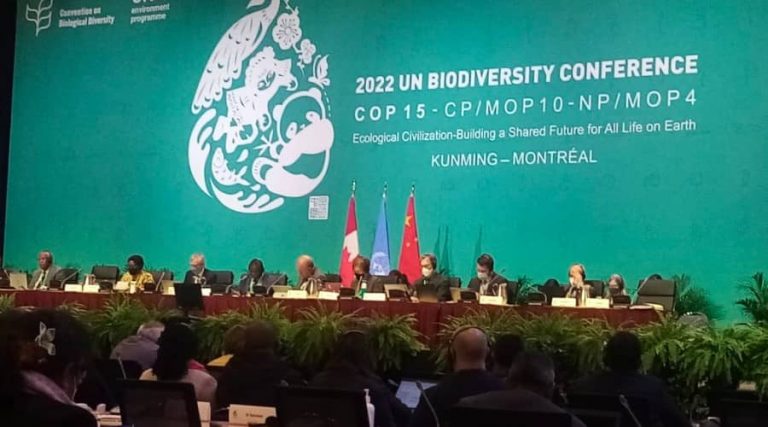
The world's ecosystems are being used as "playthings of profit," according to UN Secretary-General Antonio Guterres, who warned that failing to reverse course would have disastrous consequences.
At the inauguration ceremony for the biodiversity conference in Montreal on Tuesday, he declared, "Humanity has become a weapon of mass destruction with our insatiable desire for unregulated and unequal economic growth."
The Conference of the Parties (COP15) to the Convention on Biological Diversity's (15th conference), which runs from December 7 to 19, will feature nearly 200 nations (CBD).
The conference's primary goal is the adoption of the Post-2020 Global Biodiversity Framework, an international road map for the long-term conservation, restoration, and management of biodiversity and ecosystems.
One third of all land is badly degraded, and fertile soil is disappearing. Climate change and pollution are speeding up the degradation of the oceans, putting one million species at risk of extinction.
According to Guterres, "We are treating nature like a toilet." "And eventually, we are killing ourselves by proxy," with negative repercussions on employment, hunger, illness, and mortality.He continued, "This meeting is our opportunity to stop this orchestra of death.
halting the loss of biodiversity
At a rate not witnessed in 10 million years, species are extinction. According to a 2022 UN Global Land Outlook study, up to 40% of Earth's land surfaces are deemed to be degraded.
The summit is being attended by more than 10,000 people, including government representatives, scientists, and activists in response to demands from environmentalists and companies to safeguard natural resources and stop the extinction of species.
The two-week UN summit is expected to result in a deal that guarantees there will be more "nature" — living things, healthy ecosystems, and plants — in 2030 than there is at present. But the 196 governments that have signed the CBD must all agree on the method by which that progress is pursued and assessed.
The cornerstone commitment to conserve at least 30% of their land and sea areas by 2030, also known as the "30-by-30" aim, is one of the 10-year framework's draft targets. Currently, less than 8% of the world's ocean is protected, compared to only around 17% of the world's land area.
The new objective will heavily rely on the participation of Indigenous peoples, who look after the land where about 80% of the planet's remaining biodiversity is found.
Conflicts continue.
On the crucial topic of funding, disagreements have already surfaced, with wealthy nations being pressured to give underdeveloped countries more money for conservation.
The draft agreement is still littered with bracketed language, showing a lack of consensus, according to the negotiators. Earlier versions of the accord featured roughly 900 brackets, but during discussions leading up to COP15, that number grew to about 1,400.
Some of the more challenging decisions include whether to include initiatives to reduce greenhouse gas emissions, whether to set a timeframe for phase-out of pesticides, and how to guarantee that developing countries would have the funds necessary to rehabilitate degraded areas.
The lack of world leaders other than Canadian Prime Minister Justin Trudeau has already dampened expectations.
Trudeau emphasized the significance of nations achieving the "30-by-30 objective." He added that Canada would contribute $350 million to the global finance of biodiversity.
In contrast, it is predicted that starting in 2030, economic losses due to environmental deterioration will total $3 trillion yearly.
Trudeau stated that there were numerous conflicts between the governments. "However, nothing else matters if we as a global community cannot agree on something as fundamental as conserving nature."
The UN talks on biodiversity, which are held every two years, have never received as much attention as the UN talks on climate change, which are the main environmental concern of the world. However, there is growing recognition that preserving the environment and halting climate change go hand in hand.
The ability to limit global warming depends on maintaining healthy ecosystems like forests and seagrass meadows. Rising global temperatures are also endangering many ecosystems and species that are unable to adapt fast or migrate to cooler regions.
China presently chairs COP15, but due of the COVID outbreak, it will not be hosting the conference.
The summit was originally scheduled to take place in Kunming, China, but COVID forced four postponements, leading to an agreement to move the meetings to Montreal.
[zombify_post]

0 Comments