



















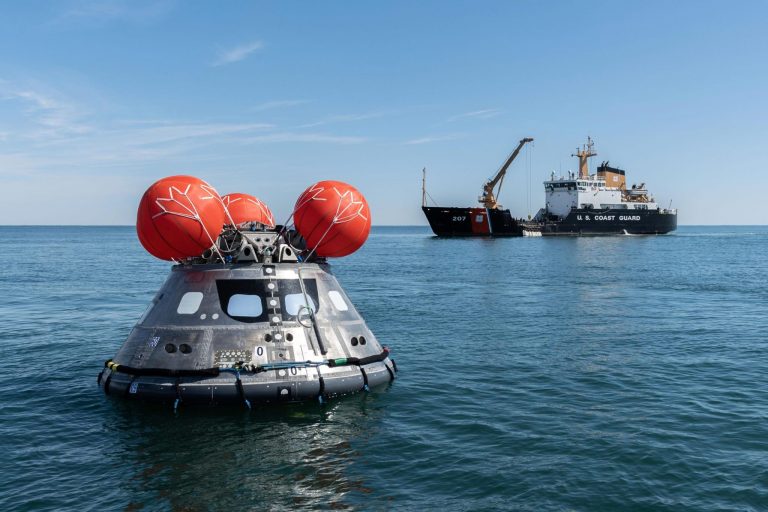
50 years to the day after the last Apollo moon landing, NASA's Orion spacecraft has completed its first mission to the Moon by splashing down in the Pacific Ocean following an unmanned orbit around the Moon.
A crucial test of how future lunar astronauts would safely return to Earth was carried out on Sunday at 9:40 a.m. Pacific Standard Time (17:40 a.m. GMT) when the gumdrop-shaped Orion capsule, carrying a dummy crew of three mannequins wired with sensors, plunged into the water off Mexico's Baja California peninsula.
When it shed its service module during its descent, it plunged into Earth's atmosphere at a speed of 39,400 kilometers per hour (24,500 mph). This exposed a heatshield that reached peak temperatures of about 2,760 degrees Celsius (5,000 degrees Fahrenheit).
The most recent phase of NASA's mission to the Moon comes to an end from Tranquility Base to Taurus-Littrow to the serene waters of the Pacific. Rob Navias, a NASA commentator, remarked, "Orion, back on Earth," during a live feed.
The 25-day mission was completed with the return, which came less than a week after Orion flew past the Moon at a distance of 127 kilometers (79 miles).
A little over two weeks ago, the capsule traveled roughly 434,500 kilometers (270,000 miles) from Earth to its farthest point in orbit.
The Apollo replacement program
The Orion mission launched on NASA's brand-new giant Moon rocket on November 16 from the Kennedy Space Center, beginning the successor Artemis program to Apollo.
The project, named after Apollo's legendary twin sister, intends to send humans back to the lunar surface this decade and build a permanent base there as a first step toward future Martian exploration by people.
By chance, the events surrounding the capsule's return on Sunday coincided with the 50th anniversary of Gene Cernan and Harrison Schmitt's Apollo 17 Moon landing on December 11, 1972.
They were the final of 12 NASA astronauts, all of whom were white men, who made moonwalks over the course of six different Apollo missions beginning in 1969.
The most crucial part of Orion's mission, re-entry tested the new heat shield's ability to endure atmospheric friction and safely shield the astronauts who would be on board.
Mike Sarafin, the mission manager for NASA's Artemis I spacecraft, stated at a briefing last week that "that is our priority-one target." No arc-jet or aerothermal facility on Earth is able to replicate hypersonic re-entry with a heat shield this massive, according to the statement.
Next flight is anticipated in 2024
Even though no one was aboard the $4 billion test flight, NASA managers were ecstatic that the dress rehearsal went off without a hitch, especially after so many years of flight delays and overspent budgets.
Hurricanes and fuel leaks combined to cause significant delays in the late summer and early fall.
The following Orion lunar orbital mission is scheduled for 2024. On board will be four astronauts. A two-person lunar landing might occur as early as 2025 after that.
A woman and a person of color will be sent to the Moon for the first time as part of this initiative.
Putting people on the upcoming journey, according to Nujoud Merancy, director of NASA's exploration mission office in Houston, will "ratchet up the excitement."
In her lifetime, she had never heard of anyone going to the Moon. So, this is the exploration about which so many of us have fantasized.
[zombify_post]

0 Comments