



















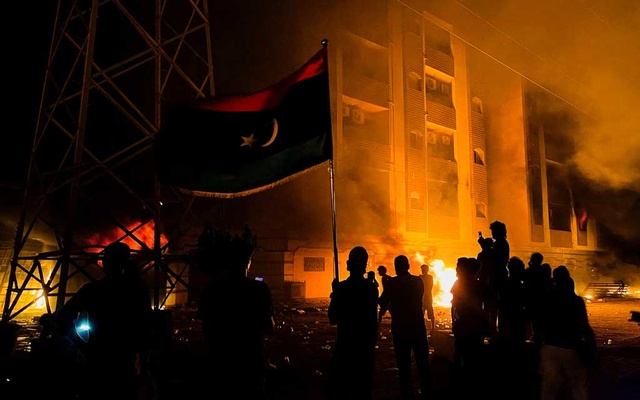
A senior UN representative for Libya has denounced the irate protesters' invasion of the parliament's offices as part of nationwide demonstrations against the country's economic unrest and political impasse.
Numerous protestors attacked and set fire to government structures, including the House of Representatives in the eastern city of Tobruk, as they marched through the streets of Tripoli, the nation's capital, and other Libyan cities on Friday.Stephanie Williams, the UN's special envoy for Libya, wrote on Twitter on Saturday: "The people's right to peacefully protest should be respected and protected but riots and acts of vandalism like the storming of the House of Representatives headquarters late yesterday in Tobruk are totally unacceptable."
"It is imperative that the situation remain calm, that appropriate Libyan leadership be shown, and that everyone exhibit caution."The leaders of the parliament and another legislative chamber stationed in Tripoli failed to reach an agreement on elections during negotiations in Geneva that were mediated by the UN the day before the protests on Friday. According to the UN, the current point of contention is the criteria for applicants' eligibility.Due to obstacles like legal issues, dubious presidential candidates, and the existence of rogue militias and foreign combatants in the nation, Libya was unable to hold elections in December.
The attempt by the international community to bring peace to the Mediterranean nation was severely hampered by the inability to hold the poll. After hesitant moves toward unification over the past year, it has launched a new chapter in its protracted political standoff with two competing governments now claiming control.While former interior minister Fathi Bashagha receives backing from the House of Representatives in Tobruk and military renegade Khalifa Haftar, interim prime minister Abdulhamid Dbeibah heads a government with its headquarters in Tripoli.unstable circumstance
The oil-rich country's severe economic circumstances, including rising fuel and food prices and frequent power outages, have also sparked protests.
Political conflicts have also harmed Libya's energy sector, which has seen a series of compelled oil facility closures since April.
In an effort to force a transfer of authority to Bashagha, whose attempt to assume office in Tripoli in May was quickly thwarted, supporters of the eastern-based administration have turned off the oil taps.The closures and decreased gas output have caused more than $3.5 billion in losses for Libya's National Oil Corporation, which has an impact on the nation's electrical grid.
There have been numerous clashes between armed groups in Tripoli over the past few weeks, raising concerns about the possibility of another major conflict.
Sabadell Jose, the representative of the European Union in Libya, urged demonstrators to "avoid any form of violence." The demonstrators wanted "change through elections and their views should be heard," he claimed, and this was proved by Friday's protests.
Since Muammar Gaddafi's overthrow and death in 2011, a NATO-backed rebellion in Libya has left the country in a state of civil war.
Years were spent at that time divided between opposing eastern and western regimes, each of which was backed by a separate armed force and a different foreign power.
[zombify_post]

0 Comments