



















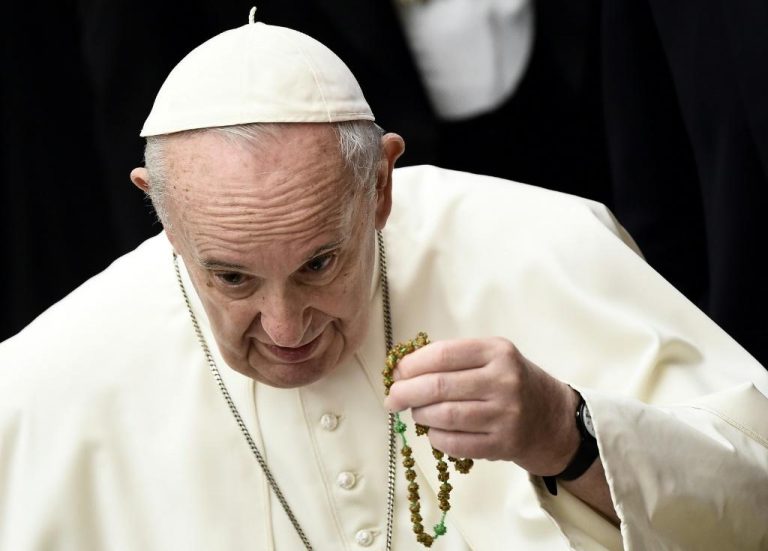
As he completed a six-day "tour of penance" to Canada that drew mixed reviews, Pope Francis apologized once more for the "evil" committed by Catholic Church members at residential schools.The pope visited the northern territory of Nunavut's capital, Iqaluit, on Friday to meet with survivors of residential schools informally and take part in a public ceremony before departing for Rome.
When he arrived in the city, which has a population of roughly 7,700 people, he shook hands with members of an Indigenous delegation who were present to welcome him. He was also greeted with cheers at the beginning of the ceremony, which started with traditional Inuit song and dancing.
"I just finished listening to some of you who attended residential schools. Pope Francis addressed the gathering, saying, "I thank you for having had the bravery to share your stories and your enormous sorrow, which I could not comprehend.
"This simply rekindled in me the outrage and guilt I have been feeling for months… I want to apologize to you and beg your pardon for the wrong done by many Catholics who worked to enact policies of cultural assimilation and enfranchisement in these institutions.Over 150,000 Indigenous children were required to attend residential schools for decades between the late 1800s and the 1990s. The pope apologized for them for the first time in Canada at the beginning of the week.He remarked at a gathering on Monday in Maskwacis, outside Edmonton in the western province of Alberta, "I humbly request pardon for the evil committed by so many Christians against the Indigenous peoples," calling the results of the institutions "catastrophic."
The bulk of Canada's 139 constitutionally required residential schools, which a panel of inquiry ruled in 2015 amounted to "cultural genocide," were run by the Catholic Church.
The church has been called upon by Indigenous leaders to apologize for its role in the residential school system for many years, and this week's papal apology has been hailed by some survivors as a critical step toward healing.Others have urged Pope Francis to go beyond apologizing for the sins of church people and recognise the institutional role played by the Catholic Church in the abuses committed at residential schools.
Murray Sinclair, the former chair of the Truth and Reconciliation Commission of Canada (TRC), said in a statement this week that "despite this historic apology, the Holy Father's statement has left a deep hole in the acknowledgement of the full role of the Church in the Residential School system, by placing blame on individual members of the Church."Sinclair stressed that the Church was a key co-author of some of the darkest episodes in this country's history, not merely a mere participant in government policy or an agency of the state.The Doctrine of Discovery, which was outlined in papal bulls from the 15th century and stated that European colonizers could claim any territory not yet "discovered" by Christians, has also been urged by indigenous leaders and community advocates. Pope Francis has been urged to revoke the Doctrine of Discovery.
The papal bulls were important in the European conquest of the Americas, and Indigenous peoples in the area are still affected by them today.
The legalized control of all territories on North America, sometimes known as Turtle Island, was based on these papal decrees. The Haudenosaunee External Relations Committee said in a statement on Wednesday that it "remains interwoven in the constitutional, legislative, and judicial systems in Canada and the United States."
"Apologies to Indigenous Peoples are meaningless without action. The Vatican ought to rescind these papal bulls and advocate for indigenous peoples' land rights in tribunals, legislatures, and other forums around the globe.
The extradition from France of a Catholic priest accused of sexually assaulting children in the northern territory, where he was based between the 1960s and 1990s, has become a significant priority of Inuit communities in Nunavut.This Thursday, the Department of Justice claimed to have requested Johannes Rivoire's extradition, according to Canadian media agencies. It didn't give any more information.
[zombify_post]

0 Comments