



















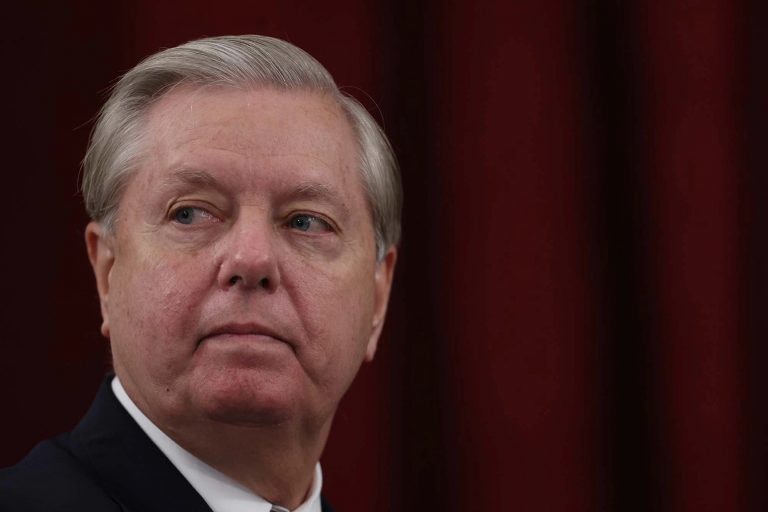
Despite reaching new heights of political fame during the Trump administration, sen. Lindsey Graham (R-S.C.) is currently the subject of a criminal investigation that is connected to the 2020 presidential election's contest for Georgia.Graham and other Trump officials have been subpoenaed by a special grand jury in Fulton County as part of an investigation into possible criminal meddling in the Georgia 2020 election, which Joe Biden won by a razor-thin margin of 12,670 votes.In a statement released on Wednesday, Graham's attorneys claimed that the senior senator from South Carolina was neither a target nor a subject of the probe, which they called a "fishing expedition."
His lawyers, Bart Daniel and Matt Austin, declared they would challenge the subpoena in court, increasing the likelihood of a drawn-out legal conflict.
"Sen. Graham was perfectly within his rights to discuss with state authorities the protocols and procedures of administering elections in his capacity as chairman of the Senate Judiciary Committee. The subpoena issued today would undermine the constitutional balance of powers and a member of Congress' ability to do their duties if it were to stand, they warned in a statement on Wednesday. Sen. Graham intends to contest the subpoena in court and believes he will win.
The district attorney's office for Fulton County declared on Wednesday that, if required, it would intervene in the relevant court to compel Graham's appearance.
Democrats claim Graham deviated significantly from standard Senate oversight practice with his actions after Trump narrowly defeated Georgia.
Shortly after Biden narrowly won the state, Graham called Georgia Secretary of State Brad Raffensperger to ask him about the legitimacy of thousands of votes.
Insiders in the Senate were taken aback by Graham's decision to contact Raffensperger directly rather than delegating what he described as an information gathering task to staff.
Ray Zaccaro, a Democratic strategist and a former Senate staffer who worked on voting rights legislation, said, "It's obviously concerning that a United States senator is being questioned about the events surrounding Donald Trump's efforts to convince Georgia officials to reject the election results."
"Lindsey Graham does not speak for the Georgian government. Although Lindsey Graham serves in a formal legislative capacity, he is not an investigator, an election official, one of the president's attorneys, or a representative of the president, according to the speaker.
Although Graham was the chairman of the Judiciary Committee at the time, Zaccaro claimed that "it was not the way the committee would conduct any kind of scrutiny."
It was unorthodox and definitely strange, he added. Nothing about his position as chairman of the Judiciary Committee at the time, as far as I am aware, would have justified his activity.
Graham's legal team maintains that he is neither the target nor the subject of the investigation into criminal election meddling, but his involvement in the investigation raises concerns about the possibility that he could eventually be charged with a crime.
Graham could seek defense under the "Speech and Debate" section of the Constitution, which shields politicians from arrest while doing their official duties, according to Stanley Brand, a former general counsel to the House and expert in congressional ethics.
He noted that Graham contacted Raffensperger before he and other senators were going to vote on objections to the certification of Biden's victory on January 6. "I think there are, arguably, speech and debate implications here, not the least of which would be his internal deliberations with his colleagues given that this was something that was going to be voted on," he said.
Brand, though, said that Graham's interactions with state authorities outside of Congress have complicated the legal argument.
How much of his chats with Raffensperger would be revealed is the trickier question, he claimed.
Brand acknowledged that the Judiciary panel has oversight responsibilities, but he also cited "dicta" from the Supreme Court's Gravel v. United States decision from 1972, which stated that the "errands" that legislators run with government agencies are not covered by the speech and debate clause.
He replied, "That's virtually a question-by-question determination," adding that the speech and debate clause's safeguards are mostly based on potential court decisions.
Some Democratic legislators believe that Attorney General Merrick Garland would act on the recommendations made by the House select committee on January 6 to look into and indict Trump's closest circle in relation to their efforts to thwart Biden's 2020 candidacy.
Last month, federal agents searched the residence of Jeffrey Clark, a former Justice Department attorney who, in recent testimony before Congress, allegedly attempted to convince Trump to appoint him as attorney general in order to enable him to send a letter to Georgia election officials purporting to "identify significant concerns" with the state's election results.
According to testimony made public by the House select panel, more Trump supporters who were subpoenaed by the Fulton County D.A. actively participated in a plan to prevent the certification of Biden's victory. Subpoenas were also issued to Rudy Giuliani, Trump's personal lawyer, as well as John Eastman, Cleta Mitchell, Jenna Ellis, and Kenneth Chesebro, lawyers who support Trump.
Shortly after Graham called him, Raffensperger, Georgia's chief election officer, expressed his shock at Graham's apparent suggestion to find a means to invalidate properly cast ballots in an interview with The Washington Post.
At the time, Graham called Raffensperger's assertion "crazy" and stated that he was only attempting to comprehend how Georgia election law operated.
"How do you safeguard the integrity of mail-in voting, and how does signature verification operate, is the key concern for me." said he.
More than a year and a half later, that assertion is the subject of extensive investigation by the media, the colleagues of Fulton County D.A. Fani Willis in Congress, and others.
More information has come to light as a result of the House Select Jan. 6 committee's investigation since it was reported that Graham twice contacted Raffensperger and his staff about checking Georgia's absentee ballots for possible fraud. This information indicates that there was a planned and concerted effort by Trump allies to scuttle Biden's 2020 victory.
There are questions regarding the senators' statements that Graham was taking part in a fact-finding mission without any desire to exert pressure on election authorities due to his strong friendship with Trump and regular access to the president.
Davidson College in North Carolina's Issac J. Bailey, a professor of public policy and communications studies, pointed out that Graham originally maintained Trump at a distance during the 2016 race but eventually was drawn to his influence.
He said that calling Georgia's election officials was motivated by Graham's strong friendship with Trump.
The old Lindsey Graham, according to Bailey, "would never have gotten himself into this situation, would have never gone on the phone to persuade politicians in another state to alter the outcome of an election."
He claimed that after initially holding Trump at a distance and correctly pointing out the danger that many of us saw in 2016, he "simply ceded all of it to get into Trump's good graces."
Given Trump's enormous popularity in South Carolina, Republican strategists do not anticipate Graham suffering any electoral damage at home
"Given the makeup of the South Carolina electorate, particularly the Republican Party and the normal Republican voter in the state of South Carolina, I'm not sure that Graham is helped by the simple act of becoming involved in this. According to James Wallner, a former Senate Republican assistant who now teaches about Congress and American constitutional law at Clemson University, "it's not like he's going to get penalized at the polls for that."
The legal repercussions, according to Wallner, are harder to forecast.
We can't write that chapter until we get there, he replied, because what happens next is a different story.
[zombify_post]

0 Comments