



















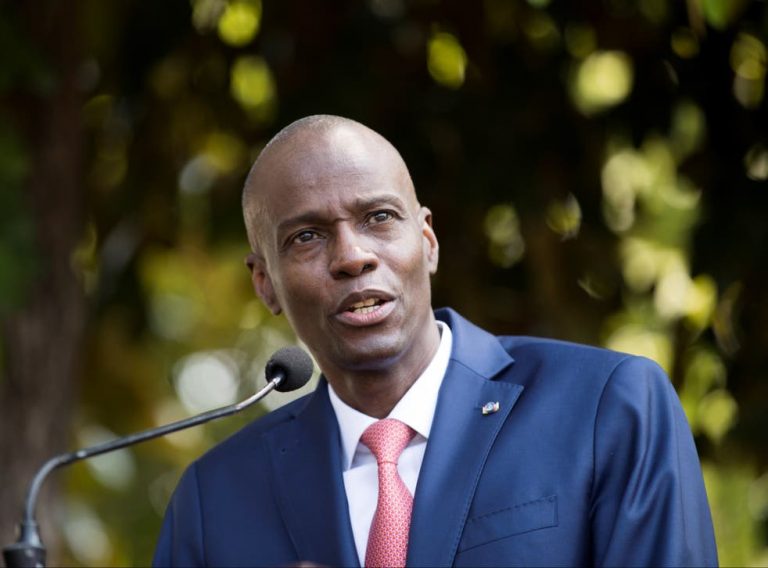
Jovenel Moise was assassinated in his home one year ago by a group of armed mercenaries, furthering the political unrest in the already unstable Caribbean island.
The murder of Moise on July 7, 2021, shocked the entire globe and sparked demands for justice, accountability, and a comprehensive inquiry to ascertain who was ultimately responsible.A new wave of gang violence in Haiti was also brought on by the president's savage murder, which the UN human rights head recently described as reaching "unimaginable and unacceptable" proportions.The examination
According to local media, a fifth judge was chosen in late May to oversee the Haitian inquiry into Moise's slaying after the previous justices resigned for a variety of reasons.
Several Colombian nationals have been among the dozens of persons who have been detained so far in connection with the investigation, but things have moved slowly and there are still many unanswered issues and competing ideas about how Moise died.
According to Haitian news source Le Nouvelliste, Moise's wife Martine, who suffered injuries in the attack on their Port-au-Prince house on July 7, said this week: "I have so many questions without answers."
Martine recalled the assassination in an interview with The New York Times in July last year, saying she pretended dead as the gunmen, several of whom were speaking in Spanish, shot her husband. They then looked through his files before departing. She claimed, "The only thing I saw before they killed him were their boots."
Three men have been accused by the US in connection with the murder, allegedly participating in a scheme to either abduct or kill the president of Haiti. John Joel Joseph, a former senator from Haiti, was accused in May after his extradition to the US from Jamaica.Mario Antonio Palacios, a former soldier for Colombia, and Rodolphe Jaar, a dual citizen of Chile and Haiti, are the other individuals accused.According to the US Department of Justice, the scheme, which was first intended to kidnap Moise in an alleged arrest operation, "ultimately led in a plot to kill the president" and included a group of about 20 Colombian nationals and a group of Haitian Americans.
A Jordanian national sought by Haitian authorities in connection with the assassination was denied extradition this week by a Turkish court.
When Moise was assassinated, he was reportedly "working on a list of influential politicians and businesses involved in Haiti's drug trade, with the intention of handing over the dossier to the American government," according to a New York Times investigation from a year ago. According to Haitian officials, hit squad members who were apprehended stated during interrogations that getting hold of that list was a key objective.
The top public prosecutor last year accused Prime Minister Ariel Henry of being complicit in the killing because of phone calls he allegedly made to one of the suspects, and his name has also come up in the probe. The prosecutor was later fired after the prime minister vehemently denied the accusations.Political ambiguity
Before his passing, Moise incited popular outcry by asserting that his presidency would expire in 2022 even though eminent jurists, human rights organizations, and other experts said he should leave office in 2021. Due to the fact that few Haitian institutions were operating, Moise had been governing by decree.
However, when his term officially ended on February 7 of this year, there was even more ambiguity since Henry, who Moise chose and who took office less than two weeks after the murder, was deemed to be an invalid president by some.
Henry, who was supported by the Core Group of countries—which includes, among others, Canada, France, the US, and the UK—has asserted he can hold onto his position until elections are held and has urged a vote to be held as soon as feasible.But in the midst of the political crisis in September, he postponed presidential, legislative, and a constitutional referendum elections indefinitely. He has also opposed the Montana Accord, a citizen-led effort that would have established a two-year transitional government and was developed by prominent Haitian civil society organizations.
In an editorial published earlier this year in the Miami Herald, Henry, the nation's de facto leader, rejected that idea. He wrote: "A president cannot be named, nominated, or selected by any group of individuals or organization… Only elections can lead to progress.
He most recently asked Haitians to work together to reconcile amid severe differences on June 23. In order to reconstruct our democratic institutions, he wrote on Twitter, "this is a must if we want to restore security, deal with armed gangs and their sponsors, [and] establish an atmosphere conducive to the staging of elections with high turnout."
US Congressman Andy Levin had criticized Henry's "rush toward elections" in April and encouraged US President Joe Biden's administration to support a Haitian-led solution to the country's challenges.
If Mr. Henry thinks the US government will support him without qualification, he will have little motivation to engage in good faith negotiations, according to Levin's article in The Washington Post.
The Biden administration has "called on all Haitian parties to establish consensus on a unified way forward towards free and fair elections when those conditions permit," US State Department spokesman Ned Price said in a statement to reporters on May 31.a lot of violence
Haitians are suffering as a result of the political impasse.
Michelle Bachelet, the UN High Commissioner for Human Rights, stated in mid-May that "armed violence has reached inconceivable and intolerable proportions in Haiti," forcing thousands of people to evacuate their homes in Port-au-Prince due to an increase in gang-related attacks.
Over the past year, strong Haitian gangs have taken control of neighborhoods in Port-au-Prince, vital roads connecting the city to the rest of the nation, and fuel depots. The latter of these events caused a terrible fuel crisis.
The UN said that during coordinated armed attacks in Port-au-Prince from April 24 to May 16 alone, at least 92 people who had no affiliation with gangs and another 96 others who were allegedly gang members were slain. Kidnappings for ransom have increased in the meantime.
The UN said last week that the violence is also keeping thousands of Haitian youngsters from attending school. According to government statistics, 1,700 schools in Port-au-Prince have been closed since April 24, denying education to 500,000 pupils.
Many Haitians have been compelled to leave their nation due to the terrible conditions, with families being forced to travel in unsafe ways across Mexico and Central America in order to reach the US.
Aboard the midst of a record-breaking number of such migration attempts, the US Coast Guard reported late last month that it had deported almost 100 Haitian men, women, and children in "an overloaded sailing vessel" off the coast of Florida.
[zombify_post]

0 Comments