



















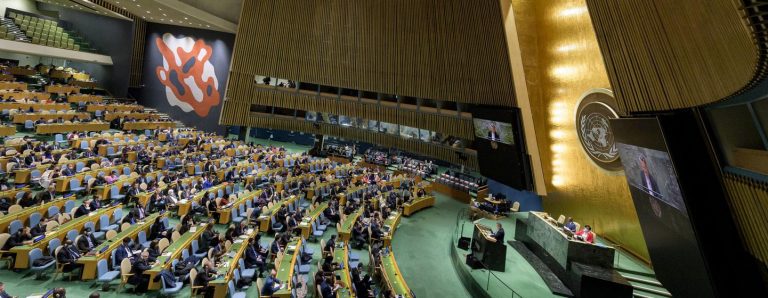
The 77th session of the United Nations General Assembly has begun in the midst of numerous serious global issues, such as natural disasters, unstable economies, shortages of essentials like food and fuel, conflicts within and between countries, cultural wars, and populist nationalism. The geopolitics of the world's superpowers, however, is weakening the UN's agenda and impeding the multilateral collaboration required to address the world's numerous crises as they battle and collide over Ukraine (and Taiwan).
Over a hundred world leaders have arrived in New York, with two notable absences—the leaders of Russia and China—and two notable attendances—the leaders of the United States and the United Kingdom, who will likely speak out vehemently and passionately against the Russian war in Ukraine and in support of the essentially in place Ukrainian leader.Volodymyr Zelenskyy, the president of Ukraine, will be the center of attention. He has been given special permission to address the global parliament via video link, just as he did to other national parliaments this year. The recent success of his army's counteroffensive against Russian aggression will accentuate his statements as they reverberate throughout the UN building.
Zelenskyy implored world leaders to "wake up" and confront the difficult issues his and other countries are facing in his speech to the UN last year, but the world marched into an even bigger, deadlier fight with eyes wide open
The outcome of this conflict will have significant effects on not only Ukraine but also the rest of the world. And it might be up to French President Emmanuel Macron and Turkish President Recep Tayyip Erdogan, who have worked closely with both sides since the Russian invasion, to put up a plan to put an end to it. Their UN addresses could indicate whether a deal is feasible.Many international leaders want the crisis to be over with as soon as possible so that the UN can concentrate on other pressing crises like Yemen, Libya, Afghanistan, Syria, Mali, and Palestine.The UN Security Council's (UNSC) agenda has already been dominated by Russia's war in Ukraine, leaving no room for other important concerns that demand global attention. While the UNSC has made some headway in Libya, Yemen, and Mali on the diplomatic and humanitarian fronts, it has failed spectacularly in Ukraine as the major countries continue to exploit it as a political football to score points against one another.
This week, expect more of the same as dozens of world leaders who are infatuated with the sound of their own voices convert the "high-level debate" into a low-level rant, brag about their successes, or lay responsibility for their failings on others. Their speeches will use lofty language and pessimistic predictions about the future of the earth, but they will only make token mentions of cures, obligations, and duties.Therefore, Ukraine will keep enlarging and widening the gap between Russia and China in the East and the United States and Europe in the West. With the four making up roughly 60% of the global economy and possessing all of the UNSC veto rights, anticipate their conflict and collision to drain the United Nations' resources and paralyze the multilateralism that may help the world combat global disasters. Additionally, they are the world's largest polluters.
Josep Borrell, the head of EU foreign policy, is correct when he claims that the Russian invasion of Ukraine has demonstrated how our world is "formed by naked power politics, where everything is weaponised" in a ferocious narrative war. However, let's be clear: the causes of such geopolitical tensions are shared by both Eastern and Western powers. Sadly, Western powers have fallen short of their lofty ideals, and Eastern nations have not taken their obligations to the international community seriously. Both sides hypocritically invoke international law and standards only when it suits them.The statement made by UN Secretary-General António Guterres that "the decisions we make – or fail to make – today might end in greater breakdown and a future of perpetual crises, or a breakthrough to a better, more sustainable, peaceful future for our people and planet" is also accurate. That will depend on how well-coordinated the UN is.Putting exaggeration aside, we are in better shape than ever as a human civilization in terms of life expectancy, wealth, health, and education, as well as in terms of science, industry, technology, and other fields. And if there is a desire to do so, we are better equipped than ever to face global concerns.
But when it comes to caring for the weaker and less fortunate, we have completely failed. Long after vaccinations were created, COVID-19 has caused an unnecessary death toll of one million extra individuals so far this year. Additionally, more than 800 million people—150 million more than before the pandemic—are now food insecure.
As we trash the environment and mistreat our planet, we are also intentionally failing the younger generations. We have harmed mother nature more recently than we have in millennia. It is no longer possible to dismiss the extremely hot summer, the terrible fires, floods, and droughts as isolated coincidences.Climate change has already begun, it is a reality, and it won't wait for geopolitics to calm down. However, it is still not too late for global leaders to act morally, to put an end to hostilities and begin the healing process. There is always a way forward where there is a will.
[zombify_post]

0 Comments