



















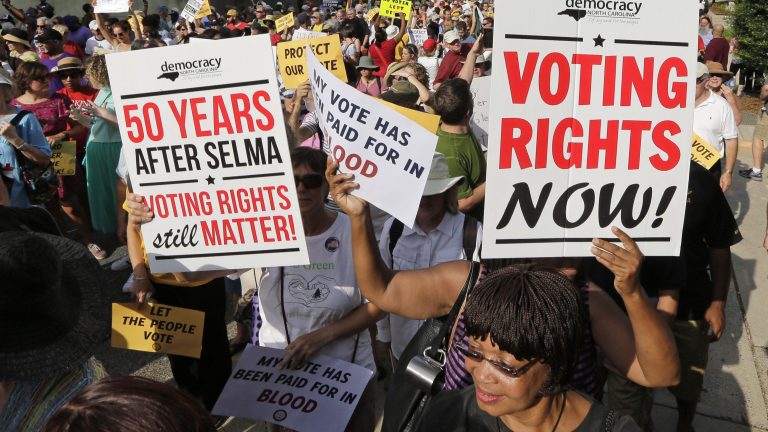
The 1965 Voting Rights Act, a key achievement of the civil rights period that sought to protect minority voters from racial discrimination, provided certain protections, but in recent years the United States Supreme Court has diligently worked to weaken those guarantees. The nation's top court will now determine whether to remove some of the last remaining pretenses to justice and equality in the US political democracy, six decades after the law's ratification.
Remember that this is the same court with a conservative majority that recently overturned Roe v. Wade and issued other terrible rulings, including one that established the right to carry a pistol outside the home. By the way, that happened only one month after the mass murder of 19 children and two adults at the Uvalde elementary school.
The Supreme Court is now deliberating on a prominent issue involving the congressional redistricting plan adopted by the Republican-controlled legislature of Alabama in the wake of the 2020 census. The redistricting plan violates the Voting Rights Act in a rather blatant way. Although there are more than 27 percent of Black people in Alabama who are of voting age, only one of the state's seven congressional districts actually offers African American voters a chance to pick a candidate they choose.
A lower federal court ordered Alabama to update its racially biased map by January 2022 in time for the November midterm elections. The state filed an appeal with the Supreme Court, which overturned the lower court's decision and authorized an accelerated hearing. In the current state of affairs, voters in Alabama will cast their ballots on November 8 using a racist map that is against the law.
One of Alabama's clever defenses is that considering racial concerns will only serve to perpetuate racial discrimination. This is analogous to stating that it is sexist to address sexism or that two plus two equals yellow.
Meanwhile, another ongoing Supreme Court case involving the subject of gerrymandering, this time in North Carolina, may have important ramifications for the 2024 presidential election. A new congressional district design that was created by the state's Republican-controlled legislature was overturned earlier this year by the state's Supreme Court for flagrantly partisan districting violations of the state constitution.
The legislature argued that the court's decision to impose an alternative map was unlawful, and presto! The US federal Supreme Court is now debating whether to endorse the so-called "independent state legislature doctrine."
A formal endorsement of this notion, which has previously been considered a fringe idea, would provide US state legislatures "broad authority to gerrymander electoral boundaries and adopt voter suppression measures," according to the Brennan Center for Justice at New York University School of Law. Without the involvement and supervision of bothersome institutions like state supreme courts, partisan legislative bodies would acquire almost unfettered power and influence over the course and outcome of federal elections.
If the Supreme Court approves of gerrymandering, the effects won't be limited to North Carolina or Alabama. However, such judgments would be typical at the highest court in the country. The Supreme Court has "essentially regained its usual function as a regressive and anti-democratic force," according to Chase Madar, a New York attorney and frequent commentator on law and politics.
The court has moved to systematically deny voting rights to minorities over the past 15 years while also overturning campaign finance laws to give Big Money an even greater influence in US politics. In high-profile cases decided in favor of discriminatory voting methods in 2013 and 2021, the court severely attacked the Voting Rights Act itself. And while though some of the key figures in the "anti-democratic" judicial movement are still on the bench, such as Justices John Roberts and Samuel Alito, the court has now been able to move even further to the right.
Undoubtedly, it would not be stunning if the Voting Rights Act were further gutted in 2022. After all, one of the US's greatest strengths is institutionalized racism. And given the state of the nation, "redistricting" – even if done equitably – won't change the disproportionate rates of poverty and incarceration that affect ethnic minority neighborhoods, or the disproportionate targeting of African Americans by armed police officers.
The National Democratic Redistricting Committee's chairman, former attorney general Eric Holder, was recently reported as saying that the Alabama and North Carolina Supreme Court decisions "may determine whether or not the United States stays as the democracy that we have come to love." Unfortunately, we take a democracy that upholds the ideal of "one person, one vote," Holder lamented.
Holder's hallucination that his cherished "democracy" has always been about "one person, one vote" is maybe his greatest regret. Consider the Electoral College, a mysterious and odd tool of structural racism that continues to choose the leader of the free world every four years despite the will of the US people.
Obviously, neither does the corporate plutocracy that rules the US qualify as "rule by the people"; instead, the people of the US must deal with widespread socioeconomic conflict, inequality, a lack of access to basic rights and healthcare, and bipartisan bombing campaigns to "democratize" other nations. Massive amounts of money pour into US political campaigns and advertising, which only serves to highlight the entire electoral farce.
With regard to the Supreme Court's support of the US political farce, Madar observed that "the fact that a majority of the current court was appointed by persons who lost the popular vote but got to be president nevertheless speaks to a severe rot in US democracy."
The Supreme Court's decision in any of the gerrymandering cases is still up in the air, so whatever the outcome, you can expect that the rot will persist for some time to come.
[zombify_post]

0 Comments