



















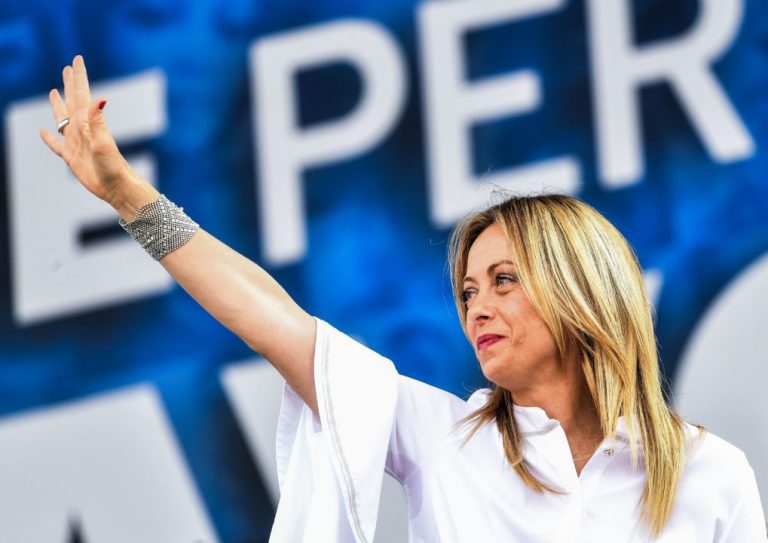
The 20th-century dictator Benito Mussolini's de facto heir, Georgia Meloni, has been referred to as a fascist, an extremist, and to some extent.She also appears to be on track to become Italy's next prime minister, having won the support of many voters who are sick of the nation's acrimonious politics and are willing to give someone new a chance. New and quite contentious.Parliamentary elections in Italy, which has had seven governments in 11 years, are taking place this Sunday. Pre-election surveys have Meloni's Brothers of Italy party in the lead. She would be the first female prime minister of the country and the first far-right leader since Mussolini if it is successful.
Her likely win sheds light on Italy's ambivalent attitude toward its fascist past. At a recent fundraiser dinner for Meloni, many of the voters we spoke with said their support wasn't motivated by any particular ideology, but rather a general dissatisfaction with national politics.
The pattern is pervasive in Europe. The shockingly ultra-conservative Sweden Democrats party received 20% of the vote this month in Sweden. With each subsequent election, Marine Le Pen, a second-generation right-winger and frequent presidential contender in France, has seen her support rise. Viktor Orban of Hungary recently denounced the "mixing of races" while publicly advocating a "illiberal democracy" and shutting down academic programs and civil-society organizations. The European Parliament recently voted to declare that Hungary "can no longer be regarded a true democracy," but rather "an electoral autocracy," in which fundamental democratic principles are not upheld, as a result of the prime minister's statements and actions.
According to the treaty establishing the European Union, member countries are required to uphold certain principles, including "respect for human dignity, freedom, democracy, equality, the rule of law, and respect for human rights, particularly the rights of persons belonging to minorities." These ideals are frequently opposed by far-right politicians and those who support them, particularly when it comes to immigration and LGBTQ people.
From Europe to Asia to the United States, traditional democracy is suffering as renegade politicians erode public confidence in the democratic process.
Analysts claim that anti-immigrant sentiment, dissatisfaction with established politicians, and general discontent with the economy and future prospects are what are driving these developments. For historical support, it is simple to go to the fascist history in nations like Italy.
Several right-wing political parties are making advances in areas of Europe, and Meloni, 45, has gained support for her staunchly anti-immigrant views. This is in response to the influx of hundreds of thousands of people leaving Syria and other countries. She received harsh criticism for including a video of an alleged rape in an Italian city by an immigrant into her campaign.
Meloni advocates for what she refers to as traditional Christian principles and is against abortion as well as same-sex unions and parenthood. She shouts at rallies, "Yes to the natural family!"
She has promised to lower taxes, and this week she claimed she would cap gas prices. She has stated that she is prepared to lead and that she intends to maintain the unity of her right-wing coalition despite some divisions. Although she frequently reverts to more extreme stances, she has made an effort to moderate her positions in order to appeal to a wider segment of the Italian voters.
She responded to those who would brand her a threat to democracy, a narrative, she claimed, propagated by the left, in a video made in Italian, English, and French. "For the previous decade the left has managed to stay in power… not by winning election… but through under-the-table arrangements," she said.
Her admirers describe her as charming and pragmatic.
The 62-year-old manager of an insurance company, Daniela Romano, described her as "coherent, practical, and resolute with a true character." She should become Italy's first female prime minister, in my opinion.The dinner's estimated 2,000 attendees included Claudia Capecchiacci, a representative of a leather goods company, who concurred.
Capecchiacci, 36, said of the candidate, "She is believable and one of the few politicians who hasn't forged alliances. "That changes things."
The administration of Prime Minister Mario Draghi fell in July after many parties, including Meloni's, declined to support his coalition in a vote of confidence. This set the stage for the elections that will take place on Sunday. Unhappiness with Draghi's leadership was driven by rising inflation and similar crises.
The Italian Social Movement, a neofascist organization founded in the 1940s by Mussolini loyalists soon after his overthrow and subsequent assassination as World War II was coming to a conclusion, is the ancestor of Meloni's Brothers of Italy party. Italy and Nazi Germany were allies under Mussolini.
Meloni has teamed up with the flamboyant 85-year-old former prime minister Silvio Berlusconi's center-right Forza Italia and the far-right League.
After a decade in which Italy has either been controlled by technocrats or compromise candidates since elections failed to deliver a clear winner, Meloni's supporters claimed she was a likely bet to become prime minister.
Health consultant Paola Baccani, 59, said, "It will be the first time in years the appointment won't be about exchanging favors."
The 59-year-old Luciano Panichi, a worker for a lighting company, downplayed the sporadic claims of fascists masquerading as local council members in Meloni's party. "Fascism doesn't exist anymore, and the left has its share of crazies," he declared.
None of the primary motivations Italians gave for choosing Meloni, according to Lorenzo Pregliasco, director of the polling company You Trend, was ideological. He claimed that because she has never worked for the government, people view her as "coherent" and a fresh face. According to him, she is viewed as a politician who did not become powerful by striking deals with other politicians.Pregliasco asserted that given budget constraints and other issues, she would have "limited margins to maneuver" in terms of how radical her proposals may be.
I don't anticipate seeing a lot of "identity" politics in the near future, but if she needs to increase her popularity, she might incite a fight against immigration, he added. But I don't see her taking a direct shot at Italy's abortion or same-sex civil union laws.
She has made an effort to moderate her stances, but she has also pushed to reassure the Italian voters that she will not leave the EU while still supporting others who are adamant about doing so, like Orban. While also condemning him, Meloni expressed affinities with him and even with Vladimir Putin, the president of Russia. The fact that Meloni failed to denounce Mussolini is one reason why many people believe the flip-flop was done for political reasons.
Many Italians, according to author Aldo Cazzullo of the recent book "Mussolini Il Capobanda," have a favorable opinion of the former dictator, which he described as a kind of historical revisionism.
"The majority believes that up to 1938, Mussolini was successful. He had to slightly tighten the reins, but it was required. He only allied with Hitler and passed racial laws in 1938," he claimed.
The reality is that he violently seized control and, by 1938, had already murdered rivals, said Cazzullo. It was not a tactical mistake to start the war. It was a logical outcome of fascism.
Carlo Bastasin, a senior scholar with a focus on Europe at the Brookings Institution in Washington, predicted Meloni will likely take a more traditional stance when it comes to governance, particularly with regard to the European Union and financial markets. Money from those sources is contingent on nations upholding fundamental democratic ideals.
In a study he conducted for the think tank, he claimed that, statistically speaking, Brothers of Italy's ascent was comparable to that of all other anti-system parties in Italy from the 1990s onward. The current changes, while traumatizing for Italy's political culture, appear to be a fresh instance of the same dynamic, with isolated parties emerging and riding successive waves of the country's unrelenting protesters. Since the revival of anti-political feeling in the early 1990s, those waves haven't stopped breaking.
[zombify_post]

0 Comments