



















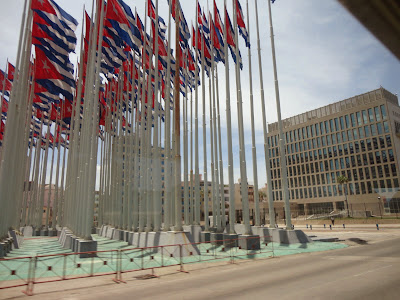
Five years after Washington shut down consular services in Havana due to a string of inexplicable health occurrences, the country has reinstated full immigrant visa services at its embassy in the nation's capital.
The embassy announced last week that it will start processing immigrant visas on Wednesday. These would include authorizations for Cubans who were reunited with family members in the US as well as others who were selected through the diversity visa lottery.
Numerous Cubans have been compelled to leave the country since 2017 in order to apply for US visas in third nations, most notably Guyana in South America.
Melissa Vazquez, 18, said after completing her application on Wednesday, "Everything went extremely fast." She added that she had been anticipating seeing her father, who resides in the US, for seven years.
She said, "I have to go [back] and get my visa, then I can go."
The resumption of services coincides with record levels of immigration from Cuba to the US, which has fueled demands that the administration of US President Joe Biden, despite a historically difficult relationship, provide more legal paths to Cubans and begin a discussion with the Cuban government.
The highest-level diplomatic discussions between the two nations since relations soured under Biden's predecessor, Donald Trump, were conducted in April of last year to discuss the migrant issue.
According to data from US Customs and Border Protection, however, with the Caribbean island beset by economic and political issues, Cubans are now the second-largest nationality to cross the US border after Mexicans.Authorities in the Florida Keys, a chain of islands off the southern coast of the United States, declared a "humanitarian catastrophe" earlier this week when more than 500 migrants and refugees—the majority of whom were from Cuba—arrived by boat in a matter of days.
The decision to increase consular and visa services was made, according to the US embassy in Havana, to "guarantee safe, lawful, and orderly travel of Cubans." Tourist visas are still not currently available.
Bruno Rodriguez, the foreign minister of Cuba, hailed the restoration of services on Wednesday as a "necessary and right move," but he suggested that the US take additional action.
He tweeted that the procedure "doesn't currently include non-immigrant visas, which restricts family visits and cultural, sporting, and academic interactions, which #Cuba continues to be open to."After embassy workers reported a string of health issues known as the Havana Syndrome, which US intelligence specialists believe may be related to sonic attacks, US consular and visa services were shut down in 2017.
The closure exacerbated tensions between the two countries, which had subsided under President Barack Obama's administration due to his tightening of US sanctions against Cuba.
Washington has loosened several limitations under Biden, particularly those pertaining to remittances and family travel from Miami to Cuba. However, many Cubans had hoped that Biden's government would bring the country back to its "Obama period" before now.
There are still limitations on both US tourist travel to Cuba as well as the import and export of a number of items. Additionally, Cuba continues to be included on the US's list of nations that "support terrorism," and it was most recently added to a list of nations that restrict religious freedom.Biden and his top officials condemned the Cuban government's repression on anti-government protests in 2021, which led to new US sanctions and visa bans on Cuban officials.
By restoring visa services, Biden is "trying to recalibrate his approach towards Cuba, seeking a middle road between Trump's "maximum pressure" and Obama's "rapprochement," according to Jorge Duany, a Cuba expert at Florida International University.
However, he continued, "for the time being, there haven't been many changes in American policy toward the island.
Cuban officials, meantime, have frequently praised measures to reopen visa services and voiced hope about talks with the US.
A "shared purpose" of both nations, according to Carlos Fernandez de Cossio, deputy minister of foreign affairs for Cuba, is to ensure migration through secure and authorized channels.
Cossio claimed that "there is no question that a strategy aiming to degrade the living conditions of a population is a direct driver of migration," but he also attributed the exodus of tens of thousands of Cubans to US sanctions.
[zombify_post]

0 Comments