



















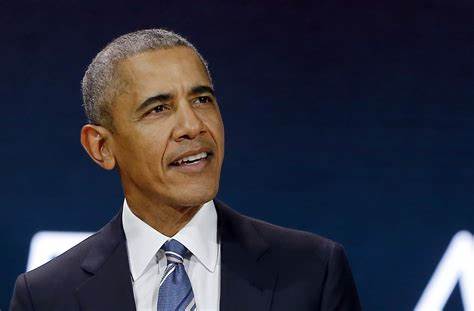
Barack Obama did something that politicians rarely do: he told the truth throughout his historic first run for the Democratic presidential nomination.
At a 2008 event in San Francisco, Obama was questioned why Pennsylvania's working class "continued to vote against their interests and elect Republicans," as he recounted in his biography "A Promised Land." "It's not unexpected then that they feel bitter, that they cling to firearms or religion or antipathy toward people who aren't like them, or anti-immigrant sentiment, or anti-trade sentiment as a way to explain their grievances," he remarked after speaking of voters who felt neglected and unheard.Obama spent days trying to navigate the criticism after Huffington Post published the secret statements. Senator John McCain, who went on to become the Republican presidential contender, accused Obama of repeating "liberal elitist" remarks. Pundits saw him as disconnected from the struggles of ordinary (white) Americans.
Senator Hillary Clinton, Obama's primary Democratic opponent, delivered some of the most venomous barbs. She stated, "Pennsylvanians do not need a president who looks down on them." Clinton started talking about growing up in a "churchgoing household" and how her father taught her to shoot a gun when she was a kid, eager to burnish her folksy credentials.
Later, Obama labeled his remarks "my campaign's biggest error." However, there is a deception in what he claimed. There isn't one to be found
Obama stated nothing that wasn't true. Obama spoke of decades of white grievance (without mentioning race) and its devastating impact on a country where millions would rather protect guns as a "God-given right" (which they are not) than protect even its most vulnerable citizens, sounding more like the community organizer he once was than the president he aspired to be.With the massacre of 19 children and two teachers in Uvalde, Texas, that impact was once again felt in a state where it's easier to get an abortion, teach the award-winning "1619 Project" in schools, or find gender-affirming health care for trans youth than it is to buy and carry a gun without a permit. Guns now outnumber people in the United States.
However, many people chose to attack the messenger rather than educate themselves about the message 14 years ago, especially since the messenger was a Black man with a foreign-sounding name whose native-born American citizenship, and thus his eligibility to be president, was already being questioned by racists like Donald Trump.
Trump used white grievance as a campaign slogan and a raging right-wing movement in his own presidential campaign. On the day he announced his candidacy in 2015, he slammed Mexican immigration, appealed to Second Amendment gun rights supporters, and promised his supporters that he would return the status they claimed had been taken away from them.
This mentality fueled the violent Jan. 6 uprising and feeds the so-called great replacement hypothesis, which claims that white people are being replaced by immigrants and people of color on purpose. Tucker Carlson of Fox News popularized it, and Republican lawmakers have adopted it. It's also turned into a deadly rallying cry for white nationalists like the man accused of shooting ten Black people in a Buffalo supermarket on May 14.
This is the "antipathy toward individuals who are different from them," as Obama put it. A majority of Trump supporters now agree with the instigating tenet of replacement theory; more people should have followed what was clearly a warning.
"Michelle and I grieve with the families in Uvalde, who are suffering anguish no one should have to bear," Obama said in a series of tweets following the Uvalde massacre. We feel bad for them as well. Our society is frozen, not by fear, but by a gun lobby and a political party that have demonstrated no desire to act in any way that could assist prevent these tragedies nearly ten years after Sandy Hook — and ten days after Buffalo."
Obama, as president, would never bring up the issue of white grievances in this country again. If America's first Black president "walked on ice but never fell," as Ta-Nehisi Coates put it in his epilogue to the Obama years, it was partly owing to his hard-learned habit of avoiding the thinnest and most slippery areas of an unforgiving surface.
"I screwed up and don't appreciate being misunderstood," Obama said in his memoir of his 2008 comment. He didn't make any mistakes, and his political foes knew exactly what he was talking about. That's why they tried to use it against him cynically, to demonstrate their winking affinity with white voters fearful of a Black guy running for president.
Obama's self-described "blunder" served as a mirror to white America, revealing what it still refuses to acknowledge. His remark was regarded as an unforced blunder in the midst of that tumultuous campaign. It was, on the contrary, foreshadowing.
[zombify_post]

0 Comments