



















At a summit with China, Russia, and the United States, Cambodia's Prime Minister Hun Sen urged for harmony, respect, and multilateralism, claiming that present global tensions have made life difficult for everyone.
As Cambodia holds the rotating chair of the Association of Southeast Asian Nations, Hun Sen was speaking at the opening of the East Asia Summit (EAS) in Phnom Penh, which was attended by 18 countries (ASEAN).In confronting the existential and strategic issues that we all face, he said he hoped leaders would embrace a "sense of oneness in sustaining open and inclusive multilateralism, pragmatism and mutual respect."
Although he avoided mentioning any specific nation, there have been long-simmering tensions between the United States and China as Beijing seeks to increase its influence in the Asia-Pacific area and Washington staunchly supports Taiwan's self-rule, which it also claims.
He launched the conference, which is taking place concurrently with ASEAN's main summit, by stating that "many contemporary issues and conflicts have been hampering our past hard-earned efforts to promote sustainable development and inflicting more hardship to people's lives."
Brunei, Cambodia, Indonesia, Laos, Malaysia, Myanmar, Philippines, Singapore, Thailand, and Vietnam are among the ten nations that make up ASEAN.
The EAS includes Australia, China, India, Japan, New Zealand, South Korea, Russia, and the United States in addition to the ASEAN nations.
Taiwan-related tensions between the US and China are still high, and the invasion of Ukraine by Russia has disrupted global supply systems, leading to food shortages and energy problems everywhere.
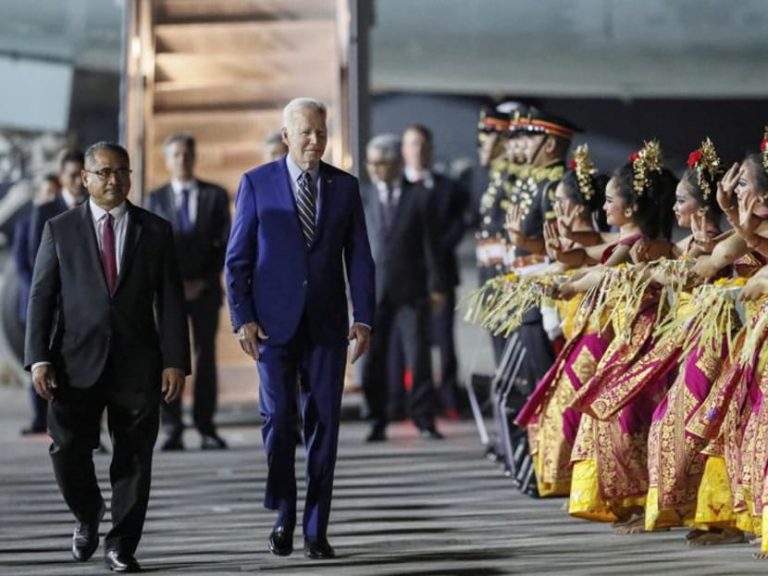
A day before their highly anticipated meeting at the G20 conference in Bali, Indonesia, between US President Joe Biden and Chinese President Xi Jinping, and Chinese Prime Minister Li Keqiang, both leaders were present at the occasion.Sergey Lavrov, the foreign minister of Russia, as well as the presidents of South Korea, Australia, Japan, and New Zealand, were present.
As relations between the US and China deteriorate, Indonesian President Joko Widodo vowed to prevent Southeast Asia from becoming the front lines of a new cold war. In 2023, his nation will assume leadership of ASEAN, and he pledged that the association would not serve as "a proxy to any countries."
At the US-ASEAN summit on Saturday, Biden pledged that Washington would work with the Asian region to create a space that is "free and open, stable and prosperous, resilient and secure." He said: "We're going to build a brighter future that we all want to see."As the world's security situation became more "turbulent," Li told an ASEAN, China, Japan, and South Korea gathering that "unilateralism and protectionism are surging, economic and financial risks are rising, and global development is confronted with unprecedented challenges."
He said that the group needed to "remain committed to supporting peace, stability, growth, and prosperity in the area and beyond, and to enhance the people's wellbeing" as key economies in East Asia.
On Sunday, Biden held separate meetings with the leaders of Japan's Fumio Kishida and South Korea's Yoon Suk Yeol to discuss how to best respond to North Korea's nuclear and ballistic missile programs as well as how to manage China's assertive behavior in the Pacific.
In the past few weeks, North Korea has launched dozens of missiles, including an intercontinental ballistic missile that prompted evacuation alerts in northern Japan ten days ago. The risk of the isolated nation conducting its seventh nuclear test in the upcoming weeks has been raised by allies.
[zombify_post]

0 Comments