



















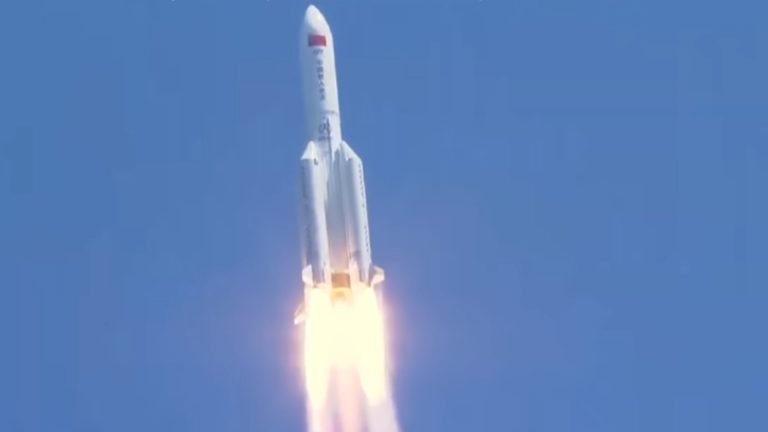
According to the Chinese government, debris from a rocket that launched a portion of China's new space station into orbit has landed in a Philippine sea.
According to a report from the China Manned Space Agency on Saturday, the Long March-5B rocket's last stage burned up almost entirely upon hitting the atmosphere.The booster would be permitted to fall unguided, the agency stated earlier.
The notification indicated the "landing spot" was at 119 degrees east longitude and 9.1 degrees north latitude but did not specify whether the remaining debris fell on land or in the sea. On the island of Palawan, waterways to the southeast of the Philippine city of Puerto Princesa are where that is located.
The Philippine authorities did not immediately respond when asked if anyone on the ground had been impacted.Twice before, China came under fire for letting rocket stages to fall uncontrolled to Earth.After pieces of a Chinese rocket landed in the Indian Ocean, NASA charged Beijing with "failing to achieve responsible criteria for their space debris" last year.
Tiangong-1, China's first space station, lost control in 2016 and plunged into the Pacific Ocean, according to Beijing. In May 2020, an 18-ton rocket fell out of control.
In 2007, China was criticized for employing a missile to take out one of its retired weather satellites, leaving behind a field of debris that other nations claimed could endanger other satellites.
The Wentian laboratory was launched into orbit on July 24 by China's most potent rocket, the Long March-5B. On Monday, it was joined to the Tianhe main module, which houses three astronauts.The authorities had reported that the remnants of a different cargo spaceship that serviced the station fell into a predefined region of the South Pacific after the majority of it burnt up on re-entry.
China has invested enormous sums of money in space travel and exploration in an effort to develop a program that accurately represents its status as a rising global power.
[zombify_post]

0 Comments