



















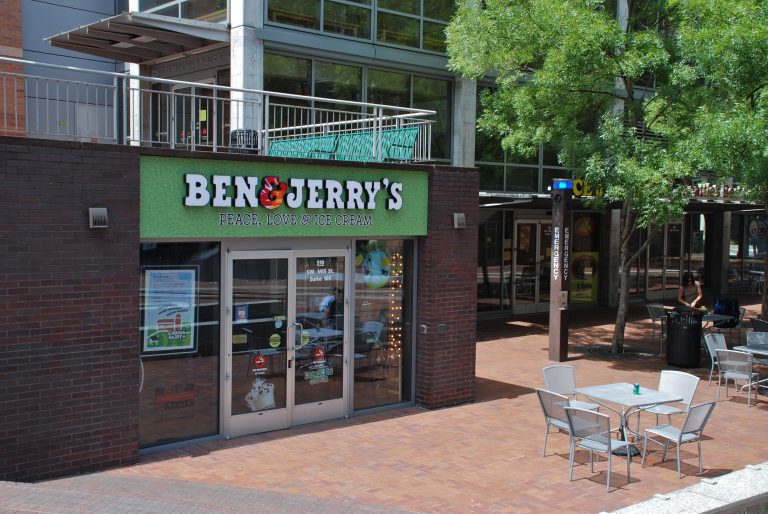
Attempts by Ben & Jerry's to prevent its parent firm Unilever from resuming ice cream sales in the occupied West Bank were rejected by a judge in the United States.
The decision by Unilever to license Ben & Jerry's products to an Israeli company, according to US District Judge Andrew Carter, did not result in "irreparable harm" to the Vermont-based ice cream company and did not, therefore, justify a court order for an injunction.Ben & Jerry's had filed a lawsuit against Unilever in July, claiming that doing business in the West Bank's occupation compromises the company's progressive humanitarian goal and misleads customers.
Ben & Jerry's was acquired by Unilever in 2000, however the agreement allowed the business to keep control of its brand and social mission. Unilever was charged with violating the merger agreement in the complaint.Carter ruled that Ben & Jerry's arguments did not satisfy the legal standards necessary for the court to enjoin Unilever from continuing its West Bank sales. According to his decision, consumers are aware of Ben & Jerry's viewpoint because of media coverage of the company's litigation against Unilever.
The products marketed in Israel and the West Bank will also not bear the Ben & Jerry's trademarks in English; rather, they will bear new trademarks in Hebrew and Arabic, the judge added. The items marketed in Israel and the West Bank will therefore be different from other Ben & Jerry's products, minimizing, if not completely eliminating, the danger of reputational injury.
Ben & Jerry's, a company that supports a variety of social justice issues, said doing business in illegal Israeli settlements is incongruous with its values and ceased sales in the occupied Palestinian territories, including the West Bank and East Jerusalem, last year.
The decision sparked an uproar from proponents of Israel, many of whom charged the company, which was established by two Jewish-American men, with anti-Semitism.Ben & Jerry's and Unilever were also targeted by several US states for the decision, which many proponents of Palestinian rights said was part of a long-standing campaign against free speech that criticizes Israel.
In order to get around Ben & Jerry's decision, Unilever opted to license the ice cream sales to a third party in Israel after nearly a year of consistent pressure, especially from the Anti-Defamation League (ADL), a vehemently pro-Israel, Jewish-American advocacy group.Israel's defenders applauded the decision and said it was a triumph over the Boycott, Divestment, and Sanctions (BDS) movement, which seeks to utilize non-violent pressure to put Israel under pressure to stop its abuses of Palestinians.
According to Ben & Jerry's, stopping sales in the West Bank is not a part of BDS.
In recent years, the US has passed a number of legislation outlawing boycotts of Israel, which has angered proponents of free speech who claim that these laws violate Americans' constitutional right to free expression and aim to silence criticism of Israeli policy.
Israel has been charged for applying apartheid on Palestinians by a number of human rights organizations, including Human Rights Watch and Amnesty International.Anti-BDS laws are a part of "broader tactics to defame and stifle meaningful solidarity with Palestinians," according to Lina Assi, a spokeswoman for Palestine Legal, a US-based organization that fights restrictions on Palestinian rights activism. She made this statement to Al Jazeera in July.
[zombify_post]

0 Comments