



















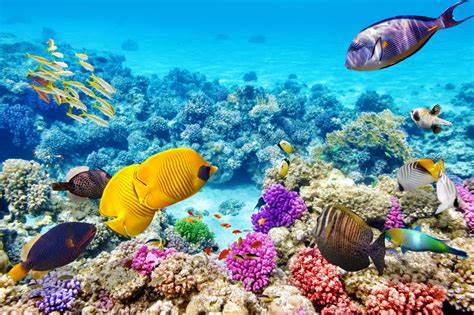
The Great Barrier Reef in Australia is experiencing its sixth mass bleaching as a result of climate change-induced heat stress, according to the reef's managers.
The news comes at the halfway point of UNESCO experts' 10-day monitoring expedition as they assess whether to add one of the world's seven natural wonders to its "in danger" list.
Aerial scans of over 750 reefs conducted by the Great Barrier Reef Marine Park Authority (GBRMPA) and the Australian Institute of Marine Science (AIMS) on Friday revealed widespread bleaching across the reef, with the most severe bleaching seen in the northern and central zones.
"More than half of the living coral cover visible from the air has been badly bleached entirely white and can show symptoms of fluorescence in the colors of pink, yellow, and blue," stated AIMS coral biologist Neal Cantin.
"During these maritime heatwaves, corals produce these luminous pigments to defend their tissue from heat and the harsh sun."When ocean temperatures are significantly higher than normal, coral bleaching occurs. Despite La Nia, which causes cooler-than-normal temperatures across the equatorial Pacific Ocean, this bleaching event has occurred.It's the first widespread bleaching in six years, and the fourth in six years since approximately a quarter of the reef studied showed signs of severe bleaching in 2020. After back-to-back bleaching occurrences in 2016 and 2017, the event occurred barely three years later. In 1998 and 2002, bleaching took place.
The coral was stressed but not dead, according to David Wachenfeld, GBRMPA's lead scientist.
"Bleached corals can recover from this stress if the temperature of the water drops. It's worth remembering that while there was a big bleaching event in 2020, coral mortality was extremely low "According to Wachenfeld,The Great Barrier Reef runs 1,400 miles (2,300 kilometers) along Australia's Queensland coast. It used to attract roughly three million tourists each year before the virus prompted borders to close.
Aerial observations with helicopters and fixed-wing aircraft this year revealed that the bleaching is worse near Townsville. Due to lower levels of heat stress, tourist sites near Cairns and Port Douglas have fared better.
When a stressed coral ejects algae from its tissue, it deprives it of a food source, resulting in bleaching. Coral can starve and die if conditions do not improve, exposing its carbonate skeleton, which turns white.
"Even the most resilient corals take about a decade to recover," according to Jodie Rummer, an associate professor of Marine Biology at James Cook University in Townsville.
"As a result, we're rapidly approaching the end of that window of opportunity. We've seen two bleaching episodes and two heat waves in a row. And the corals aren't adapting to the new environment at all "she explained.The Great Barrier Reef is showing signs of heat stress in underwater photographs obtained in 2022.
UNESCO has put pressure on the Australian government to show that it is doing enough to save the reef.
The Australian government said earlier this year that it would invest one billion Australian dollars ($700 million) over ten years to promote new climate adaptation technology, water quality programs, and reef species conservation.
While the additional investment was welcomed, global climate experts, among others, have criticized the government for not doing more to move Australia away from fossil fuels.
The country's climate action is rated as "very insufficient" by the Climate Action Tracker. "The administration looks bent on replacing fossil fuels with fossil fuels," it argues, citing the government's "gas-led recovery" program, which was unveiled in 2020 to help the country recover from an economic slowdown brought on by Covid-19's spread.
On Monday, UN Secretary-General Antonio Guterres singled out Australia as one of a "handful of holdouts" in the G20 group that had yet to announce "significant emissions reductions."The Great Barrier Reef Marine Park Authority recently finished aerial surveys of the reef's 3,000 reefs.
Countries and private companies that invest in coal, he claims, are jeopardizing the world's climate goals. He also claimed that spending money on fossil fuels and subsidies was a "dumb investment" that resulted in billions in "stranded assets."
"It's past time to phase out fossil fuel subsidies and curtail oil and gas exploration," he stated.
The true issue the government should be addressing, according to Amanda McKenzie, CEO of the Climate Council, is climate change.
"To give our reef a fighting chance, we must address the most pressing issue: global warming. Unless we reduce our emissions this decade, no amount of money will be able to stop these bleaching episodes "In a statement, she expressed her dissatisfaction with the current state of affairs.
[zombify_post]

0 Comments