



















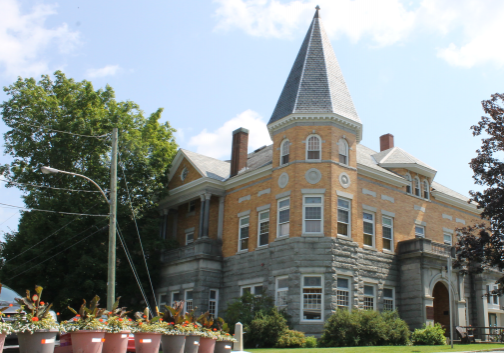
Quebec's Stanstead and Vermont's Derby Line – With stained-glass windows, a regal façade, and a slate roof, the Haskell Free Library and Opera House appears to be any other Victorian-style structure from the early 20th century from the outside.
But as soon as you're inside, you can immediately tell that the Haskell is different from most locations. This is due to the building's location at the US-Canada border, which separates some readers and theatergoers into two separate nations.The majority of the library's books are from Canada and are mostly available in English, French, and Spanish. The majority of the 500 hardwood seats on two floors at the adjacent Opera House, which is adjacent, are from the US.
The stage, however, which saw its inaugural performance in 1904 and included a painted wall design, a chandelier, and a domed roof, is located in Canada.
There is just one entry on the US side of the border, yet the building has two addresses, one Canadian and the other American. Both the children's reading area and the main entry hall of the library are divided by a strip of black tape.
The current director of the library, Melanie Aube, admitted that she no longer even realized that she was employed at a location that was both a tourist destination and home to citizens of two nearby nations.
The Haskell serves as a reminder of a period when people could roam freely in this rural area, which is between the Canadian province of Quebec and the US state of Vermont, as borders around the world grow more militarized and a sign of imposed divides between communities.
And it is on purpose.The library was the idea of a wealthy local woman named Martha Haskell, who purposefully built it between the US and Canada in a display of unity amongst citizens of the then-porous border area. It was first opened in 1905, a year after the Opera House.For many years, inhabitants of Canada and the United States often crossed the border to attend church, go to school, and even get married. Pointing to a sizable image of the founder in the entrance hall, the youthful tour guide said that Haskell's intention was to "cheat" the border.
For many years, the real border raised doubts regarding where the US ended and Canada began, as well as the opposite.
Austin T Foster, a resident of Derby Line, a small Vermont town on the US side of the border, wrote in the Vermont Quarterly magazine in 1949, "To me, as a child, and to the other children of the village, the iron post set in the curb of the wooden plank sidewalk, which marked the spot where Main Street ran into Canadian territory, was an object of interest and curiosity" (PDF).
The small village of Stanstead, Quebec, which is on the Canadian side, was founded by "pioneers from New England in the 1790s," according to the municipality's website.
Stanstead, which includes the historic towns of Beebe Plain, Stanstead Plain, and Rock Island, was formerly "a sanctuary for smugglers and bootleggers," according to the town. However, things got better after the first customs station was built in the Eastern Townships in 1821.
The fact of being in two nations at once presents its own difficulties when you are back at the Haskell.
The tour guide said that after a fire decades ago sparked a dispute between insurance companies over who had to pay for damages, a line of tape was affixed to the floor to denote the precise border line.
Its placement on the frontier also makes it impossible for workers to stay out of politics, despite their best efforts in recent years.Asylum seekers from the US have grown in recent years, and a border sign from the Canadian government that faces Vermont warns would-be border crossers that "not everyone is eligible to make an asylum claim" in Canada.
Another cautionary sign urges people not to loiter at the border and is written in multiple languages, including Russian, Romanian, and Haitian Creole.
Due to the library's advantageous location, a criminal plan that involved importing more than 100 pistols from Vermont into Quebec resulted in a Canadian man receiving a 51-month prison sentence in 2018 was also staged there against his will.
According to US police, some of the firearms were hidden in small backpacks in a container in the Haskell restroom before being removed and carried into Canada.
While the formal, heavily guarded US-Canada land border crossings are numerous and spread out over a considerable portion of the 6,416 kilometers (3,987 miles), many of them are unattended. One such crossing is located close to the library and opera theater.
A Canadian police cruiser was stationed close to the Haskell on a recent chilly December morning to watch the boundary line, but it was only there for a short while before it left.
Canadians can cross the border and approach the building's front entrance on the US side to enter. Since there isn't a legal border crossing here, passports are not necessary; however, the library advises visitors to expect their movements to be watched and to bring identification just in case.
Aube emphasized that the library itself is not a border crossing and that family gatherings are no longer permitted after dozens of relatives who were only permitted to be in the US or Canada, but not both, started showing up to share meals in the cramped area.
Aube said of the prohibition, "It's sad because it's not something we're thrilled to do. We want those folks to spend time with their families, but if we want to keep the members who give to keep the library running, we must pay attention to them.The building's designation as a national historic site makes it subject to specific regulations for renovations and maintenance under both US and Canadian laws, which presents a significant funding and maintenance problem, according to Aube.
Despite its distinctiveness, the Haskell's staff easily acknowledges that, like other libraries worldwide, attracting visitors isn't as simple as it may have always been – particularly after the COVID-19 pandemic forced a months-long closure in 2020 and 2021.
Nevertheless, the library holds regular storytimes for kids in a space that is bright and stocked with picture books, as well as a French-language book club that attracts some Francophiles from the United States, according to Aube. Today, movie screenings are also organized in the Opera House.
According to Aube, the library continues to serve several generations of local families, and yearly visits from visitors are also common. When questioned about what attracted people to the small library, she responded, "Because it's unique.
That day in mid-December, as employees and volunteers reorganized bookshelves and provided tours of the facility, a woman with a request rushed through the front doors.I want to read anything," she responded.
You've come to the proper location, the response said a short while later.
[zombify_post]

0 Comments