



















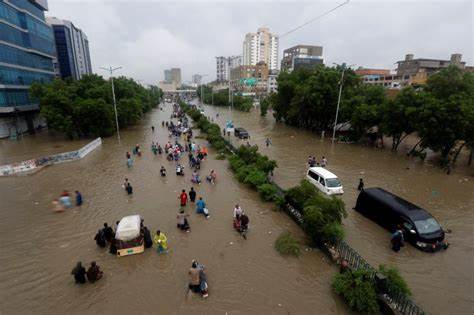
The recent floods in Pakistan have had an impact on 33 million people. More than 1,300 people, including more than 400 children, have died in the disaster, along with millions of others who have been displaced and a third of the country submerged.
Heavy monsoon rains and a strong heatwave that forced the glaciers in the Alps to melt contributed to the floods.Antonio Guterres, the secretary-general of the United Nations, called the flooding a "climate catastrophe" and a "monsoon on steroids." He cautioned that South Asia is one of the "hotspots" of the global climate problem, where deaths from climate-related causes are 15 times more likely. Pakistan makes up less than 1% of the world's carbon emissions, but it bears a disproportionately large part of the dire consequences of climate change.
Drowning became an immediate hazard as first flooding destroyed towns and villages, and many people lost their lives in this way. Malnutrition becomes a very serious issue as flooding continues to ruin crops and the highways that convey food. The most vulnerable people will suffer the most, as is typical of many natural disasters.
The floods are a humanitarian catastrophe, but they also pose a threat to Pakistan's already precarious healthcare system, bringing with them a new set of worrisome health issues.There was a considerable gap in access to health services between rural and urban communities even before the current floods. These remote locations have proved challenging to reach. The World Health Organization (WHO) said that more than 1,400 healthcare facilities had suffered full or partial damage, and that the key healthcare concern was still availability to "health facilities, healthcare staff, and necessary medicines and medical supplies."Water-borne illnesses
The potential increase in aquatic illnesses is a major issue as well. In temporary camps, those who have fled the destruction are residing, with little to no access to potable water. According to the nonprofit organization Wateraid, thousands of people have already been reported to be experiencing dysentery, and half of all water, sanitation, and hygiene facilities in some of Pakistan's hardest-hit areas have sustained significant damage.
This extremely contagious illness is an intestinal infection that results in severe, bloody diarrhoea, fevers, cramping, and sometimes fatal dehydration. Insufficiently sanitized water provides a breeding ground for the bacteria and parasites that cause dysentery, shigella E coli, and amebiasis. The most vulnerable groups to dehydration-related problems are young people and the elderly.The WHO and UN both express alarm about the spread of cholera. The bacteria Vibrio cholerae is what causes the infectious disease cholera. It is dispersed by tainted water sources. If improperly handled, it can result in hypovolemic shock from fluid loss, kidney failure, and even death. The risk of cholera spreading increases because those who catch it might pass the bacteria in their faeces for up to 10 days.
Oral cholera vaccinations and surveillance programs were being established in Pakistan prior to the floods due to an increase in cholera cases, particularly in the Khyber Pakhtunkhwa, Sindh, Punjab, and Balochistan provinces. However, many of these will have been delayed as a result of the flooding.We will experience an increase in mosquito populations as flood waters get stagnant and serve as a breeding ground for the insects. The most dangerous vector-borne illnesses carried by mosquitoes are malaria and dengue fever.Mosquitoes contain the Plasmodium parasite, which when bitten by a human releases into the circulation to cause malaria. After traveling to the liver, where it develops, the parasite exits the organ and enters red blood cells, where it multiplies. When a red blood cell's parasite population reaches a certain level, the cell is destroyed and the cycle is restarted with new parasites. Vomiting, anemia, sweating, and a fever are common symptoms. Without the proper medication, there is a chance of coma and death.
The bite of a mosquito carrying the dengue virus causes the transmission of dengue fever. High fever, headaches, rashes, swollen glands, vomiting, and bloody diarrhea are just a few of the symptoms. Dengue haemorrhagic fever, a more severe version of the illness, can occasionally manifest in dengue fever patients. It may result in fatal bleeding and death.There have already been numerous reports of skin disorders brought on by persons living in humid environments. The optimum environments for dermato-fungal infections are moist or damp skin. People expose a lot of their skin to the germs that reside in the water as they pass through floods. These bacteria and fungi grow in skin folds beneath breasts, in the groin area, and between toes since they cannot be cleaned subsequently. This causes acute itching, pain, and skin disintegration, which in turn raises the risk of secondary infections.erratic care
Additionally, there is worry that the flooding would halt the expansion of Pakistan's much-needed immunization programs.
According to the WHO, Pakistan had previously reported more than 4,500 cases of measles and 15 cases of wild poliovirus in 2022. As a large portion of the infrastructure required to obtain and distribute these life-saving vaccines washed away, children will now be at an increased risk of diseases that can be prevented by vaccination.Children also face a crisis in schooling as approximately 19,000 schools have been completely or partially devastated by the floods. For the impacted children, this lack of knowledge and the trauma of experiencing such a large-scale natural disaster will have far-reaching effects.
At least 650,000 pregnant women and girls are among the millions of people who have been seriously impacted; 73,000 of them are anticipated to give birth in the coming month. Many of these mothers, according to the United Nations Population Fund (UNFPA), do not have access to the healthcare resources and assistance they require to deliver their children safely. Many women just do not know where or how they will give birth as medical facilities and houses have been devastated.Due to a lack of access to healthcare and education, malnutrition, poverty, and a high prevalence of violence against women, Pakistan had high maternal death rates even before the floods. This was most noticeable in rural regions, which are also where the floods was most severe. Additionally, not only girls and pregnant women but also those looking to get contraception and other reproductive health services would be impacted.
Additionally, bleeding women who use pieces of cloth to soak up menstrual blood and then wash them in contaminated water supplies before using them again run the danger of contracting serious infections.
Any relief effort must acknowledge the disproportionate impact natural disasters have on women and girls, and it must plan for female-specific support.Since the disaster struck at a time when many people in the West are dealing with rising food and energy costs, there has been criticism of the slow reaction to help provision. But it would be a mistake to ignore those who are suffering from climate calamities that are mostly the fault of other nations.
The global strategy must take into account both the urgent crisis Pakistan's citizens are currently experiencing and the actions required to address the larger issue of climate change since, if nothing is done, it will inevitably have an impact on all of us.
[zombify_post]

0 Comments