



















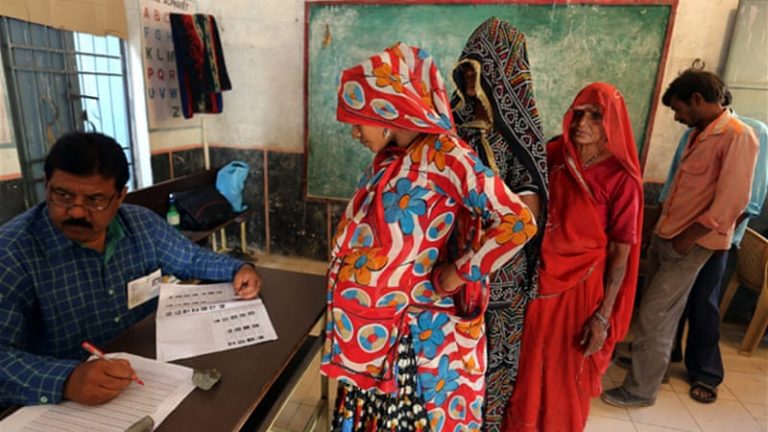
The decision by India to grant voting privileges to any Indian resident temporarily residing in Indian-administrated Kashmir has sparked outrage and fears that the Hindu nationalist government will make yet another attempt to alter the demographics of its sole area with a Muslim majority.
The decision, which was made public on Wednesday by the top electoral official of the federally administered territory, is anticipated to boost the number of voters by a staggering 30 percent, from the current 7.6 million to roughly 2.5 million additional voters.Indians, mostly Indian military personnel, employees of the public and private sectors, as well as migratory workers, would make up the new voters.
Following the repeal of Article 370, all individuals who had not previously registered to vote are now able to do so, according to Hirdesh Kumar, who also noted that the laws of the Representation of the People Act, which governs how elections are conducted in India, also apply to the area.
Article 370 of the Indian constitution, which granted the disputed region, which is also claimed by neighboring Pakistan, limited autonomy, guaranteed that voting rights in Kashmir, which is controlled by India, were only open to its permanent residents until August 2019. The ordinance forbade Indians from outside the area from residing there permanently, from purchasing land, and from working in local administration.
On August 5 of that year, two months after winning a reelection by a landslide, Prime Minister Narendra Modi's administration unilaterally removed the region's special status by dissolving the decades-old law and dividing it into the two federally controlled territories of Jammu and Kashmir and Ladakh.It was just the first in a string of legislation and actions by the government, according to locals, that try to stifle a movement for either independence or fusion with Pakistan. According to Kashmiris, the repeal of Article 370 and the ensuing legal actions are intended to alter the region's demographics.
Since then, the Indian government has passed a contentious law on domicile that gives citizenship to all Indians who have lived in the area for more than 15 years. Additionally, new legislation was passed that makes all Indian citizens eligible to purchase land in the area.
According to Kumar, registering to vote in Indian-administrated Kashmir does not require an Indian citizen to have a domicile certificate or to be a permanent resident.
Any worker, student, laborer, or other person typically staying in Jammu and Kashmir is now eligible to register as a voter, he said.Muslims make up 68.31% of the 12.5 million people that live in Kashmir under Indian administration, and Hindus make up 28.43%, according to the 2011 census. Ninety-seven percent of these inhabitants, or more than seven million people, reside in the valley.Indian opposition parties and politicians from Kashmir have denounced the government's new election regulations.
Former Kashmiri chief minister Mehbooba Mufti called the decision "the last nail in the coffin of electoral democracy" in the area.
"They (the administration) intend to impose some fascist dictators by bringing in 2.5 million voters fraudulently. According to Mufti, they seek to shift the demographics.
The 63-year-old legislator claimed that the Kashmiri government of the Bharatiya Janata Party (BJP) planned to carry out a "Nazi Germany or Israel strategy."
Hitler tortured Jews tremendously, but he was unable to exterminate them, and the same is true of Israel. The Palestinians cannot be eliminated or stripped of their resolve, no matter how severely they are repressed. The nefarious plans of the BJP would fail, according to Mufti.In 2018, the BJP and Mufti's coalition government was overthrown. Since that time, Kashmir managed by India has been governed directly by New Delhi through a hand-picked administrator and is without an elected government.Omar Abdullah, another former chief minister of the region, accused the BJP of importing people to win seats.
"Is the BJP so unsure of the backing of (Jammu and Kashmirlegitimate )'s voters that it needs to bring in temporary voters to win seats? None of these things will help the BJP when the people of J&K are given a chance to exercise their franchise,” he tweeted.
Some experts interpreted the government’s plan to add outsiders to the voting list in the region as the BJP’s “final solution in the Kashmir dispute”.
India’s defence minister Rajnath Singh had declared in July 2019 – days before Article 370 was abolished – that “the final resolution of Kashmir” was on the cards and “no power on Earth can stop it”.the redraft of the electoral map
The residents of the area said that Modi's government's announcement of a new election plan for the area in May of this year was an attempt to deny them voting rights and take away their power.
With the revised map, the region's Muslim-majority Kashmir received just one more assembly seat, going from 46 to 47, while the Hindu-majority Jammu region saw an increase of six, from 37 to 43.
The action, according to experts, was biased in favor of Jammu, which has a large Hindu population, and they charged the administration of breaking the rule that electoral seat allocation should always take the population into account.
The Kashmir territory has been controlled by India for the past seven decades, and its political system has been dominated by Muslim chief ministers who have held power in the area. But since taking office in 2014, Modi's administration has given its backers the assurance that the country will have a Hindu chief minister.
While the BJP has failed to secure a single seat in the valley, it has a sizable following in Jammu's Hindu-majority districts, where it won 25 of the region's 37 assembly seats in the 2014 elections.The right-wing party has now made an effort to gain support in the valley's Muslim population. With this most recent action, observers claim the BJP is closer than ever to achieving its goals.
A final list is anticipated to be released in November. The process of revising electoral rolls for the forthcoming assembly elections, which are scheduled to be held next year, has started.Establishment colonialism
The decision to increase voter turnout has "shaken the Kashmiris," according to a Kashmiri political analyst who declined to be named for fear of retaliation, and the next step could be to force them to leave their homes.
"It will guarantee the Muslim community's total disempowerment. They have already become a political minority thanks to numerous legislation, the analyst claimed.
The end goal of the government, according to Mohamad Junaid, an anthropology professor at the Massachusetts College of Liberal Arts in the United States, is "forced demographic change, the eviction of Kashmiris, and the erasure of Kashmiri as a political identity."
"The Indian government's actions are consistent with settler colonialism's traditional tactics, in which non-native settlers are granted privileges by executive order rather than on the basis of their democratically elected representatives. Every decision regarding Kashmir over the past three years has been made from New Delhi without the approval of the people of Kashmir, he claimed.According to Junaid, the BJP's agenda to "manufacture a BJP-led regime in Kashmir that can formally endorse the August 5, 2019 decision to revoke autonomy and split the historical state of Jammu and Kashmir" is what led to the most recent decision to permit residents of the area to cast ballots in local elections.
In Kashmir's history, "this is unprecedented," he declared. "Although foreign administrations have ruled Kashmir, they have typically not aspired to supplant the local population with a new one."
[zombify_post]

0 Comments