



















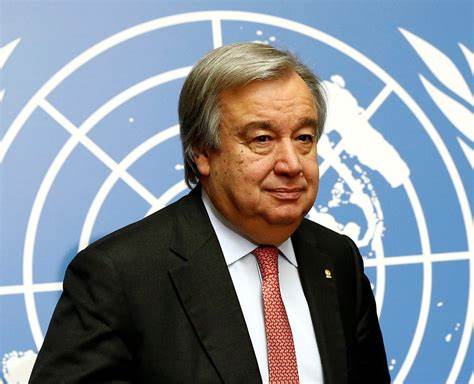
On the 77th anniversary of the first atomic bomb assault, United Nations Secretary-General Antonio Guterres stated in the Japanese city of Hiroshima that humanity is "playing with a loaded gun" as crises with the potential for nuclear catastrophe proliferate throughout the world.
On August 6, 1945, the United States unleashed the first atomic bomb, obliterating Hiroshima and killing 140,000 people. Three days later, it struck Nagasaki with a second atomic bomb, killing over 70,000 people. On August 15, 1945, Japan formally ended the Second World War.At a ceremony commemorating the first nuclear bomb's detonation on Saturday, Guterres warned of the dangers posed by the conflicts in the Ukraine, the Middle East, and the Korean peninsula while describing the atrocities endured in the Japanese city during World War II.
"In the space of a few seconds, tens of thousands of people were killed in this metropolis. The UN head claimed that "men, women, and children were consumed in a terrible fire."
What can we infer from the mushroom cloud that grew above this city, we must ponder.
Since Russia's war on Ukraine started in February, there have been growing concerns about a third atomic explosion due to Russian threats of a nuclear attack.In New York this week, Guterres warned that "crises with severe nuclear undertones are spreading swiftly." He repeated same concerns this week.
He stated, "Humanity is playing with a loaded gun.""Human beings as weapons of war"
At Hiroshima's Peace Memorial Park, survivors and their loved ones started congregating before daybreak to pay respect to the victims.
At the exact moment the device detonated, at 8:15 a.m. local time (23:15 GMT), a quiet prayer was said.Although he was not invited to the ceremony, the Russian envoy went to Hiroshima on Thursday to leave flowers at the memorial.
President Vladimir Putin has made veiled warnings suggesting a willingness to use tactical nuclear weapons ever since Russia invaded Ukraine in February
Kazumi Matsui, the mayor of Hiroshima, accused Putin of "taking the lives and livelihoods of innocent residents in another country" in his peace declaration on Saturday.
Matsui urged the world not to make the same mistakes that led to the destruction of his city 77 years ago and claimed that Russia's conflict on Ukraine is bolstering support for nuclear deterrence.
The Russian novelist of War and Peace, Leo Tolstoy, is quoted by Matsui as saying: "Never base your happiness on the sorrow of others, for only in their pleasure can you find your own."
Washington detonated a second atomic bomb on the Japanese port city of Nagasaki three days after the Hiroshima explosion, killing around 74,000 people and bringing the Second World War to an end.
According to Japanese government figures from March, there are currently less than 119,000 survivors of the two nuclear attacks who have been formally recognized.The US is still the only nation to have ever used nuclear weapons in battle.As the head of the UN, Guterres made his first visit to the Hiroshima monument on Saturday; his previous visit was postponed due of the COVID-19 pandemic.
Fumio Kishida, the prime minister of Japan, remarked at the memorial that nuclear weapons still pose a threat to the globe.
He pleaded with people all across the world, "I must lift my voice to appeal that the tragedy of nuclear weapons use should never be repeated." Japan has pledged to continue on its path toward a world free of nuclear weapons, no matter how challenging or tough it may be.
Kishida's appeal for a nuclear-weapons-free world is criticized as being hollow because Japan continues to be covered by US nuclear policy and refuses to sign the Treaty on the Prohibition of Nuclear Weapons.
The treaty, which lacks the backing of the US and other nuclear countries, is now unworkable, according to Kishida, and Japan must bridge the gap between non-nuclear and nuclear nations.
As a result of the explosions and radiation exposure, many survivors of the atomic bombings in Japan suffer long-lasting injuries and diseases and are subject to prejudice there.
After more than 20 years of work by recognized survivors, the Japanese government finally started offering medical assistance in 1968.
The health ministry reports that as of March, 118,935 survivors, whose average age is now over 84 years, had been certified as being qualified for government medical assistance. But many others still await assistance, including individuals who allege they were harmed by the radioactive "black rain" that landed outside of the initial target locations.
[zombify_post]

0 Comments