



















Australia's Canberra – According to a recent government report, Australia's ecology is "poor and deteriorating."
The newly-elected federal Labor government published the 2021 State of the Environment Report on Tuesday. This mandated review is done every five years. The previous Liberal-National coalition government had received it in December 2021, but it was never published.The report is indeed depressing, and Tanya Plibersek, the new minister of the environment, called the findings "awful" and "a story of crisis and decline."
Australia has lost more animal species than any other continent in the globe, according to the survey. Eight species of wallaby alone are among the more than 100 Australian species that have been designated as extinct or extinct in the wild.
The degradation of habitat is one major factor.
Almost half of the nation is currently used for sheep and cattle grazing, and since 1990, primary forest has been removed on an area of around 6.1 million hectares (15 million acres). Due to these modifications, Australia now ranks third in terms of the total loss of soil organic carbon, behind only China and the United States.The past five years have seen some of the worst changes, with 202 plant and animal species being listed as "threatened" during this time, bringing the total to 377 species becoming threatened in the past ten years alone. In Australia today, there are more newly introduced foreign plant species than there are locally adapted ones.Even species helped by targeted aid made very modest progress, and it is anticipated that things will get worse once the impact of the 2019–20 "Black Summer" bushfires is clearly known. Three billion animals may have perished in the bushfires or been forced to flee their homes.
The news is also bad underwater.
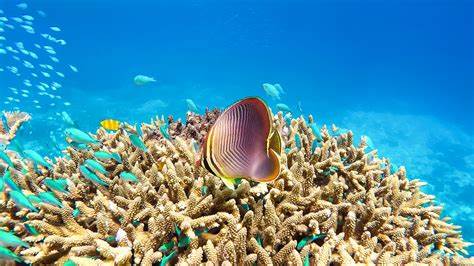
With the Great Barrier Reef witnessing massive bleaching outbreaks in 2016, 2017, 2020, and this year, ocean acidification is reaching a critical point and endangering the existence of juvenile coral. Many low-lying coastal areas are being impacted by sea level rise, including the significant Kakadu wetlands in the Northern Territory. 2019 saw record-low water levels in the Murray-Darling Basin, one of Australia's most significant river basins.The report, which for the first time has Terri Janke as its principal author from among Indigenous people, also pays close attention to Indigenous culture and knowledge.
It was discovered that Indigenous cultural heritage is still being destroyed. As an example, Rio Tinto, a major mining company, blew up portions of Juukan Gorge in 2020 to extract iron ore. Despite the traditional owners' very clear requests, devastation is still occurring."Extremes more frequently"
Numerous polls have revealed that Australians want to see more climate change action.In the May federal election, climate change was the top concern for many voters.
The Liberal party was virtually destroyed in urban strongholds by the "teal" independents who ran a fervent anti-climate change campaign, while a record number of Greens candidates were elected to the House of Representatives and the Senate. Therefore, only the big party of Labor was able to establish a government.
The terrible bushfires, floods, and storms that large portions of the country have experienced recently are thought to be directly responsible for the rise in popular support for climate action and for leaders ready to take that action.
According to Andrew King, a senior lecturer in climate science at the University of Melbourne, "Australia has traditionally been a land of extreme weather and climate fluctuation." "However, extreme weather events are happening more frequently and having more disastrous effects due to human-caused climate change.
"This research should serve as a wake-up call on the harm we are causing to the environment. To try and reduce the environmental damages we will face as the world continues to warm, we must decarbonize our business and society as quickly as we can.Who is at fault?
The previous Coalition administration received the State of the Environment report in December 2021, but they chose not to make it public before the election.The Coalition, which had been in power since 2013, is consequently eager to take the blame, according to the incoming federal Labor administration. Tony Abbott and Scott Morrison, two of the three prime ministers during that time, were blatant climate doubters, while Malcolm Turnbull was ousted by the party for wanting to take greater action on the issue.
"Sussan Ley [the Coalition's environment minister] decided to keep it secret and locked away until after the election… You'll understand why once you've read it. But Australians deserve the truth," Plibersek said after the launch, speaking at the National Press Club.
The truth is not quite so clear-cut.
It is true that the federal Coalition made few efforts to enhance the environment and actively contributed to some instances when things got worse. The Coalition was dedicated to boosting investments in coal and gas, and its strategy to reduce carbon emissions was heavily dependent on projected future technical advancement.
The fact that state and territorial governments are also responsible for the deteriorating health of the nation's environment is something that federal Labor seeks to avoid acknowledging. In actuality, sub-national governments in Australia are primarily in charge of environmental protection, and the federal government's influence is little.Labor is in charge in six of the eight states and territories that make up the nation, including Queensland and Western Australia, two states that are known for their mining industries. Since her election in 2015, Premier Annastacia Palaszczuk has authorized at least 18 new coal mines in Queensland alone. This includes a coal mine at Olive Downs that will cost $1 billion Australian dollars ($680 million).Government efforts to conserve the environment, according to Euan Ritchie, professor of wildlife ecology and conservation at Deakin University, have been a "absolute failure."
Ritchie notes "ecosystems disintegrating across the continent, extensive, frequent coral bleaching events, and bushfires decimating wildlife populations." The failure of society and the government to act on the science and evidence is exhibited by all of these incidents.
Labor's goal under Prime Minister Anthony Albanese is to reach net zero by the year 2050. By 2030, it aims to reduce emissions by 43%, which is much less than the 50–75% range that experts advise. Labor has frequently emphasized that it will continue to support the exploitation and use of fossil fuels, despite vowing to spend extensively in renewable energy.
Even though the report's dire conclusions, scientists are quick to stress out that there are still many things that the nation – its government and people – can do.
According to Kylie Soanes, an urban ecologist at the University of Melbourne, "every Australian has the chance to be on the conservation frontline: conserving species in the places they live and work." Research, according to her, has shown that there is a significant desire for nature preservation in urban areas, but that "activities occur in isolated pockets and need additional support."According to Soanes, "a mindset shift is needed to support cities as spaces for people and environment." Make nature a part of every Australian's daily experience—something they can see, enjoy, and contribute to saving—if we want people to support biodiversity and engage with environmental issues more.
[zombify_post]

0 Comments