



















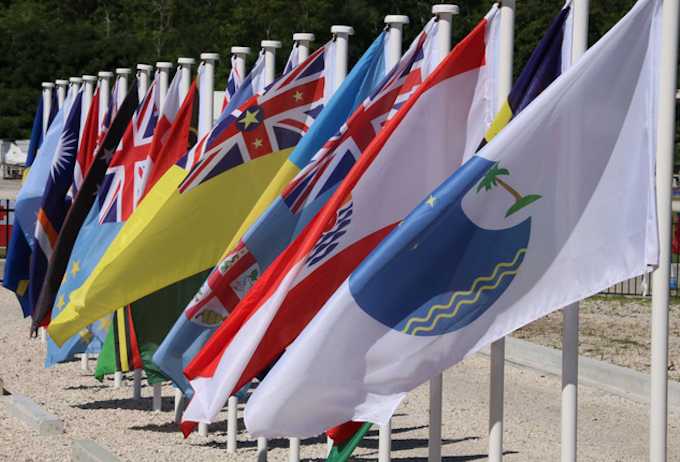
Vice President Kamala Harris of the United States admitted that Pacific island nations had not always received the "attention and support that you deserve" as she presented a significant increase in US aid and diplomacy on Wednesday.
That sentiment is shared by the poorly populated, remote island states of the area, which are now receiving attention as theaters of the intense strategic confrontation between the US and China after years of being ignored diplomatically.The US's rekindled engagement with their region is welcome, if long overdue, according to many Pacific regional leaders.
The majority of the Pacific island countries, which are congregating in Fiji for a current leaders' summit, have a GDP per capita of less than $5,000, inadequate infrastructure, and fall behind Western economies in measures like life expectancy, education, and health.
A few meters above sea level, Vanuatu, Tuvalu, Kiribati, and the Marshall Islands are among the nations that are most susceptible to climate change.
Frank Bainimarama, the prime minister of Fiji, said the US "is clearly looking a lot more like the Pacific partner we have historically regarded it to be" after Harris' comments.The US is obviously late to the party, but as the saying goes, better late than never, said Robert Bohn, a former lawmaker and advisor to Vanuatu's foreign minister.
"Since 1992, I have been urging the USA to participate in the game. A start is always excellent, but more is always better.
Bohn continued, "Some of it is certainly to counter China, but largely it is about getting back into the game."
In a video address to the Pacific Islands Forum (PIF) leaders on Wednesday, Harris announced that, pending congressional approval, funding for the region's maritime security enhancement, fight against illegal fishing, and response to climate change would be tripled to $600 million over a ten-year period.In addition, the vice president said that Washington would designate its first-ever Pacific ambassador, redeploy the Peace Corps to the area, and open new embassies in Kiribati and Tonga.
However, some people regard the US's outreach as primarily focused on controlling China, which has greatly increased its influence in the region, and this has led to skepticism and scepticism.
Chinese advances
Recent Chinese advances include convincing Kiribati and the Solomon Islands to break diplomatic ties with Taiwan, which Beijing views as a renegade province, as well as signing a security agreement with the Solomon Islands that has alarmed the US, Australia, and New Zealand.In light of a divide between Micronesian governments and other PIF members, Tebao Awerika, a government member of Parliament in Kiribati, which skipped this year's meeting, expressed doubt about Washington's intentions.
Awerika cited the removal of the US Peace Corps from Kiribati twenty years ago for alleged worries about the security of air travel and the availability of medical facilities in the archipelago, which is situated roughly midway between Hawaii and Australia.
Awerika, whose party leader, Kiribati President Taneti Maamau, supervised the diplomatic shift from Taipei to Beijing, said Al Jazeera, "They could have assisted us 20 years ago but they did not."
"The only inference is that they are helping us today because of our relationship with China," said the author.You may infer how Kiribati feels about the assistance they've chosen to offer, Awerika continued. They could have helped us enhance both our medical facilities and our national airline.Although it had taken a while, Tessie Lambourne, the head of the Kiribati opposition, welcomed the US pledge, noting that its effectiveness will depend on how it was carried out.
For a very long time, Lambourne said to Al Jazeera, "We have sought to encourage the US to return to the Pacific, to expand its presence and visibility in our nation and our region, and for the US to get the Peace Corps volunteers back to the Pacific."
Lambourne claimed that the US could do more to help the nation, whose GDP per capita of $1,670 is only marginally higher than that of Cambodia.
It's a start, but in her words, "I think the US also needs to assist with the growth and upgrading of the economic and social infrastructure." "I believe that maritime security will be a top priority for Kiribati. The true test is in that area.
However, some Pacific Islanders saw a US agenda focused on retaliating against China as a source of optimism rather than skepticism or suspicion.
The deputy opposition leader in the Solomon Islands, where Beijing assumed diplomatic control in 2019, Peter Kenilorea Jr., asserted that he feels his nation is Beijing's "front line of political warfare."According to Kenilorea of Al Jazeera, "And to some extent, People's Republic of China is winning this as we saw with the signing of the security treaty between themselves and Solomon Islands."
"Announcements are always appreciated, but probably the most crucial thing is to put the programs into action on the ground."
By offering the assistance that Pacific island states require, according to Kenilorea, the US may dispel the idea that it is lagging behind.
"There is the impression that the US is lagging behind. But concentrating on the requirements of our nations will swiftly demonstrate that the US is not keeping up with or reacting, he said. They are merely acting as allies for the islands.
[zombify_post]

0 Comments