



















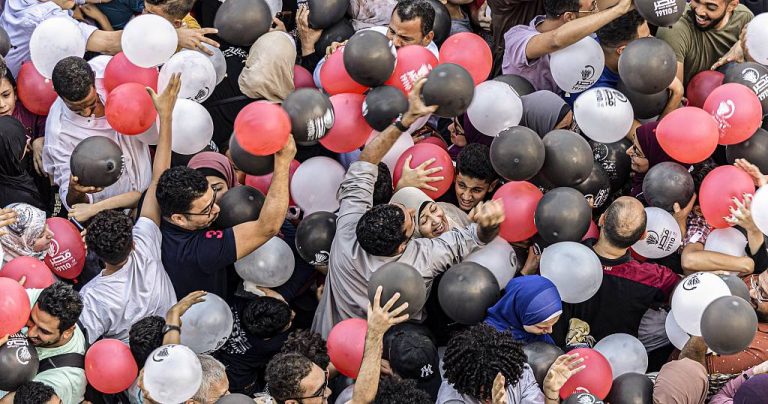
Eid al-Adha, one of the most important holidays in the Islamic calendar, is being observed by millions of Muslims around the world, including in nations like Afghanistan, Libya, Egypt, Kenya, and Yemen.
The venerated celebration, sometimes referred to as the "Feast of Sacrifice," falls on Saturday, the same day as the last rituals of the yearly Hajj in Saudi Arabia.The Quranic story of Prophet Ibrahim's willingness to sacrifice Ismail as an act of obedience to God is remembered every Eid al-Adha.
God gave him a ram as a sacrifice before he could perform it. According to Jewish and Christian legend, Ibrahim is given the command to murder Isaac, another son.For the four-day feast, many Muslims ritually slaughter animals and distribute the meat to their loved ones, friends, and the less fortunate.
The holiday will be observed on Sunday throughout most of Asia, including Indonesia, Pakistan, and India—the three nations with the greatest populations of Muslims worldwide.Thousands of pilgrims set out for Mina in Saudi Arabia at the crack of dawn. Mina is a broad valley surrounded by bare mountains where the Prophet Muhammad paused on his journey some 1,400 years ago.
This week, one million Muslims traveled from all over the world to the holy city of Mecca, making it the biggest pilgrimage since the pandemic disrupted the yearly celebration.
Pilgrims performed the symbolic stoning of the devil at the multi-story Jamarat Complex to commemorate Ibrahim's triumph over temptation. It is one among a number of ceremonies performed annually for these five rigorous days in remembrance of the Prophet Muhammad, the Prophets Ibrahim and Ismail, or Abraham and Ishmael in the Bible
The three enormous pillars that stand where the devil attempted to stop Ibrahim from offering his sacrifice were targeted by the pilgrims' pebbles.With crowds flowing back and forth, it is the riskiest part of the hajj.
In 2015, soaring crowds resulted in the deaths of thousands of pilgrims. A definitive death toll was never provided by the Saudi authorities. Since then, entry has been facilitated by bigger streets, automated gates, and a high-speed train link by the authorities.Every Muslim who has the means to finish the spiritual journey should do so at least once in their lifetime.
With a COVID-19 vaccine requirement and attendance quotas that were less than half of pre-pandemic levels, Saudi Arabia kept crowd sizes under control this year to slow the spread of the virus.
The moments were a big step closer to being normal, though. The well-known throngs flocked to the sacred locations, forgoing masks and security precautions.
Men are obliged to shave their heads at the conclusion of the journey, which is one of Islam's central tenets, and women are expected to cut a lock of hair as a symbol of regeneration.
They'll travel back to Mecca to say goodbye by circling the cube-shaped Kaaba, which stands in for the allegorically represented "house of God," before returning home and continuing to celebrate the rest of Eid al-Adha with their families.
Izhar Anjoom, an Indian pilgrim who was stoning the devil at Mina, said, "We are feeling extremely proud. We are having a great time because it is Eid today.Prices are outrageous.
Food is a highlight of this happy celebration. But many claim they cannot afford the livestock for the ritual sacrifice due to the skyrocketing food costs that have created severe hardship throughout the Middle East.The normally thriving Christmas commerce in goats, cows, and sheep has been negatively impacted by desperation over the expense of living.
Prior to the festival, there is typically a rush to buy top animals in cash-strapped Afghanistan.
But this year, soaring worldwide prices and the economic collapse brought on by the Taliban takeover have made many people unable to make a purchase of significant religious significance.
In a livestock market in Mazar-e-Sharif, northern Afghanistan, where a few men bartered over bleating sheep, Mohammad Nadir said, "Everyone wants to sacrifice an animal in the name of Allah, but they are not able to do so because they are impoverished.
Mohammad Qassim, an Afghan cattle seller, stated that he sold 40 to 50 cattle on this day last year. "I've only been able to sell two this year."Children in the beleaguered Gaza Strip's al-Shati refugee camp lined up eagerly for the innards and trotters, a prized gift for those who couldn't otherwise buy meat.
In Gaza, there were hardly any buyers at a livestock market. According to vendors, the cost of sheep feed has increased by four times recently.
Abu Mustafa, a sheep dealer in Deir al-Balah in central Gaza, complained that "our existence is full of loss." Gaza has long been plagued by rampant unemployment and poverty.
Palestinian households were reducing the amount of other dishes that were traditionally served at the feast, which typically included a wide variety of foods such offal, kaak, and maamoul holiday sweets, on the streets of Ramallah in the occupied West Bank.
Fruit merchant Baligh Hamdi lamented, "On days like this, there was demand for fruits, sweets, and nuts as well, but as you can see… no one is standing to buy now."Due to Russia's conflict on Ukraine, which has disrupted agriculture and limited energy supply, prices for wheat and meat have increased dramatically, and hunger has spread.Livestock salesmen have been compelled to boost rates because to the exorbitant costs of fertilizer and animal feed.
After more than a decade of violent instability and the past two years of the epidemic, families in Tripoli, war-torn Libya, were eager for the holiday.
However, customers were pacing around a dusty market nervous about costs for the holiday purchase because to the price tags, which might cost up to $2,100 per sheep
Really, the costs are outrageous, Sabri al-Hadi stated, appearing frustrated.However, there were also group prayers, which was a welcome sight in many parts of the world following years of limitations due to the coronavirus. On Saturday, worshippers flocked to mosques throughout the Middle East and North Africa.Crowds of worshipers worshiped together, feet to feet, from Kenya to Russia to Egypt.Sahar Mohamed in Cairo grinned broadly and said, "I feel extremely delighted that all these people came to worship.
"People are accepting and loving toward one another."
[zombify_post]

0 Comments