



















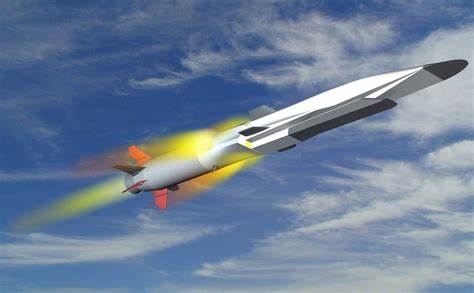
According to a defense official familiar with the situation, the US successfully tested a hypersonic missile in mid-March but kept it hidden for two weeks to avoid raising tensions with Russia just before President Joe Biden's trip to Europe.
According to the official, the first successful test of the Lockheed Martin version of the Hypersonic Air-breathing Weapon Concept (HAWC) was launched from a B-52 bomber off the west coast. The missile was driven to high speeds by a booster engine before the air-breathing scramjet engine ignited and launched the missile to hypersonic speeds of Mach 5 and higher.
The official provided little details about the missile test, stating only that it traveled at a height of over 65,000 feet and for over 300 kilometers. A journey of 300 miles takes less than 5 minutes even at the lower end of hypersonic range — around 3,800 miles per hour.
The test comes only days after Russia claimed to have launched its own hypersonic missile during its invasion of Ukraine, claiming it was fired at an ammo storage facility in western Ukraine.The employment of Russia's hypersonic Kinzhal missile by US officials was downplayed. After the Russians reported the missile launch, Defense Secretary Lloyd Austin said he did not consider it "some type of game changer." Days later, Pentagon spokesman John Kirby said it was "difficult to tell what exactly the justification" for the launch because it was aimed at a fixed storage facility.
"To take out a target like that, it's a pretty significant sledgehammer," Kirby stated at the time.The Kinzhal missile is a modified Russian Iskander short-range ballistic missile that may be launched from the air. In other words, rather than being a breakthrough in hypersonic weaponry, it is a variant of an existing technology. A more complex and challenging air-breathing scramjet engine was tested in the United States. The HAWC missile is also devoid of a warhead, depending instead on its kinetic force to kill its target.
Biden was planning a trip to NATO partners in Europe at the time of the US test, which included a stop in Poland where he talked with Ukraine's foreign and defense ministers.
The United States has avoided taking actions or making statements that could unduly increase tensions between Washington and Moscow. To avoid any misinterpretation by Russia, the United States canceled a Minuteman III intercontinental ballistic missile (ICBM) test on Friday. Austin had previously postponed the test in early March in order to prevent any moves that Russia would misinterpret at such a critical moment.
In general, the US has kept its weapons and equipment sent to Ukraine under wraps. The Defense Department listed particular equipment and weaponry alone in the most recent $300 million security aid package.
The US has also objected to the supply of fighter aircraft to Ukraine through the US, fearing that the Kremlin would view such a move as the US and NATO intervening in the Ukraine crisis.For similar reasons, US authorities kept silent for two weeks about the latest hypersonic test, according to the defense official, so as not to offend the Kremlin or President Vladimir Putin, especially as Russian forces increased their bombing of Ukraine.
The US test is the first of the Lockheed Martin version of the HAWC missile and the second successful test of a HAWC missile. The Raytheon HAWC, which is propelled by a Northrop Grumman scramjet engine, was put through its paces by the Air Force in September.
The missile's integration and release, safe separation from the launch aircraft, booster firing, and cruise all met all key objectives, according to a news statement from the Defense Advanced Research Projects Agency (DARPA). Officials also provided little specifics regarding the mission, including no indication of how fast or how far the missile flew. The missile went at a speed greater than Mach 5, according to the press statement.
Following successful Russian and Chinese tests in recent months, the US has increased its focus on hypersonic weapons, compounding concerns in Washington that the US is lagging behind on a crucial military technology.
The Biden administration sought $7.2 billion for long-range weapons, which includes hypersonic missiles, in the FY23 defense budget. The Government Accountability Office listed 70 projects related to hypersonic weapons development in a report released last year, with a cost estimate of approximately $15 billion between 2015 and 2024.
The United States experienced a setback one month after the first successful HAWC test when another hypersonic system failed. The failure occurred just days after rumors that China had successfully tested a hypersonic glide vehicle this summer, and just days after Russia claimed to have successfully tested its Tsirkon submarine-launched hypersonic missile.
[zombify_post]

0 Comments