



















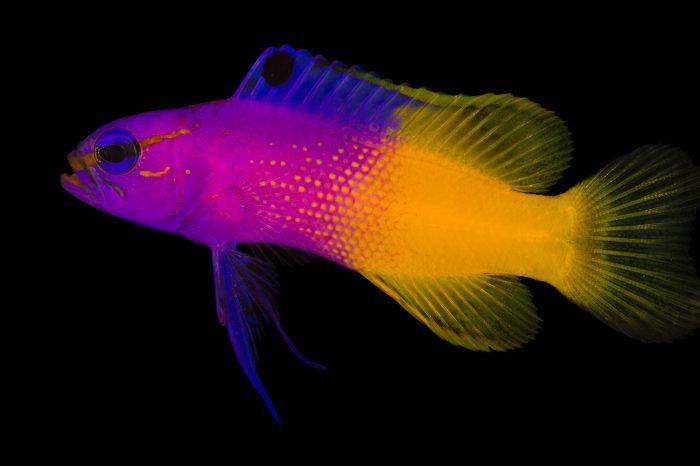
A live rainbow exists in the ocean's "twilight zone" beneath the waters around the Maldives. The rose-veiled fairy wrasse is a vibrant new species of fish to science.
Cirrhilabrus finifenmaa, the fish's scientific name, was discovered at depths of 131 to 229 feet (40 to 70 meters) below the ocean's surface.
The pink rose, the Maldives' national flower, and the fish's exquisite pink colours inspired the name. The local Dhivehi language word "Finifenmaa" means "rose."Hundreds of species survive in the waters surrounding the archipelago nation, but this is the first fish reported by a Maldivian scientist, Ahmed Najeeb. The fish was described in a paper published in the ZooKeys magazine on Tuesday.
In a statement, study coauthor Najeeb, a biologist at the Maldives Marine Research Institute, said, "It has always been foreign scientists who have documented species found in the Maldives without much input from local scientists, even those that are native to the Maldives."
"This time it's different, and being a part of anything for the first time has been incredibly thrilling, especially working alongside top ichthyologists on such an elegant and lovely species."The fish has been misidentified before. The red velvet fairy wrasse, Cirrhilabrus rubrisquamis, was first discovered in the 1990s, although researchers initially mistook it for an adult Cirrhilabrus rubrisquamis. The Chagos Archipelago, 621 miles (1,000 kilometers) south of the Maldives, had only one juvenile fish described.
In an email, senior research author Luiz Rocha, the California Academy of Sciences curator of ichthyology, said that wrasses, a family of mostly brightly colored fishes, have been documented to change color as they grow from juveniles to adults.
Many species' juveniles seem alike, but it's the adults who stand out, he says."A few months ago, Yi-Kai Tea (our first author) received (remotely controlled vehicle) footage from Chagos showing adults who were substantially different from the Maldives adults," Rocha explained. "That's when we realized the Maldivian species was new and distinct from C. rubrisquamis."
The researchers examined the height of the spines supporting the dorsal fins of adults and juveniles, counted scales, and categorizing the colors of adult males in their study.
Adult males of the rose-veiled fairy wrasse exhibit a distinctive color pattern that includes vivid magenta, peach, orange-pink, and dark purplish-red.
The discovery that finifenmaa and rubrisquamis are two different species might aid scientists in better understanding the range of these fish, which is especially crucial when trying to protect them.
[zombify_post]

0 Comments